

A small spark, a long fuse
A protest turns into a crackdown. A border incident becomes a week of threats. A drought becomes a migration crisis, then a political crisis, then a security crisis. In IB Global Politics, conflict rarely begins with a single “reason.” It starts when pressures stack up quietly, and one moment reveals how fragile the system already was.
That’s why the best IB Global Politics answers sound calm and layered. They don’t hunt for the one cause. They show how causes interact.
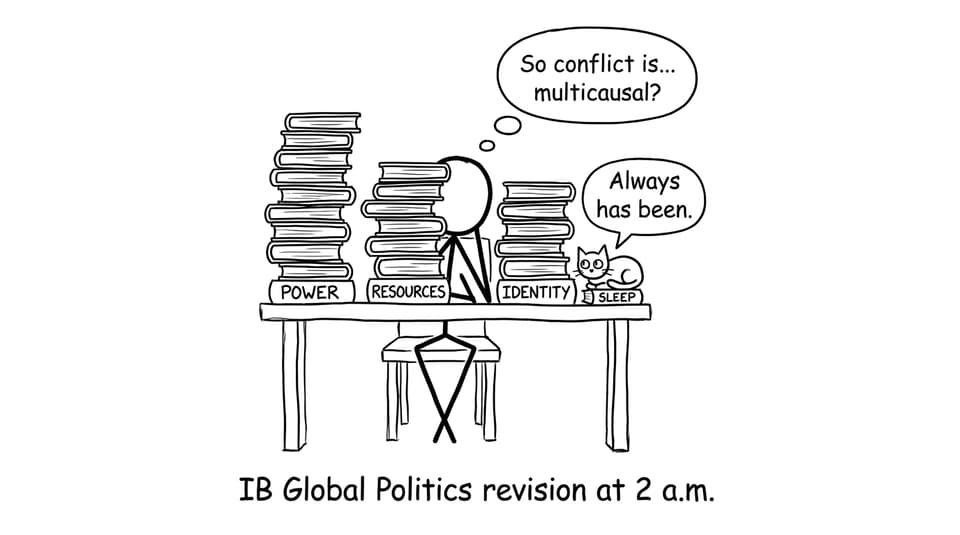
IB Global Politics conflict causes: a quick checklist
When an exam question asks what causes conflict, scan for these drivers:
-
Power and security competition (fear, deterrence, rivalry)
-
Economic stress (scarcity, inequality, resource distribution)
-
Identity and ideology (politicised ethnicity, religion, nationalism)
-
Weak governance and exclusion (corruption, repression, low legitimacy)
-
Historical legacies (borders, colonialism, past violence)
-
International influences (intervention, proxy dynamics, arms flows)
To practise turning these into arguments, start with the IB Global Politics hub and build your own sets using RevisionDojo’s IB Global Politics Resources.
Power struggles and the security dilemma in IB Global Politics
The most common engine of conflict is competition for power: who controls territory, institutions, and security. In a system without a world government, states often assume the worst about rivals. Even defensive moves (military build-up, alliances, border walls) can look offensive to others. That perception gap is where escalation lives.
In IB Global Politics, you can frame this through concepts like power, sovereignty, and security. If you need a tight conceptual refresher before writing, RevisionDojo’s topic pages help you stay precise, like Power in IB Global Politics and the Legitimacy Questionbank.
Resources, inequality, and economic pressures
Economic causes are rarely about “greed” in isolation. They’re about who feels locked out. Scarce resources (land, water, energy) can intensify tension, especially when distribution is unequal or governance is weak. Poverty can make recruitment into armed groups easier, but inequality and exclusion are often more politically explosive than low income alone.
In IB Global Politics, that’s a structural argument: institutions and policies shape opportunity, and perceived unfairness becomes grievance.
Identity and ideology: difference becomes dangerous when politicised
Ethnic, religious, and national identities exist everywhere. They don’t automatically create violence. Conflict becomes more likely when leaders politicise identity to build support, define enemies, or justify repression. Ideology can harden that divide, because it turns compromise into betrayal.
This is where high-scoring IB Global Politics analysis avoids stereotypes. You’re not claiming “identity causes conflict.” You’re explaining how identity is used inside power struggles.
Weak governance, exclusion, and legitimacy crises
When institutions fail--through corruption, repression, or unequal representation--legitimacy erodes. Groups who feel excluded may stop seeing the state as “theirs.” At that point, resistance can feel rational, even inevitable.
To revise how governance connects to justice and stability, the thematic unit pages are useful, especially Rights and Justice and Peace and Conflict.
History and outside influence: why conflicts echo
Borders drawn without regard to identities, unresolved grievances, and earlier cycles of violence all shape today’s distrust. Add international involvement--funding, weapons, alliances, intervention--and local disputes can expand fast.
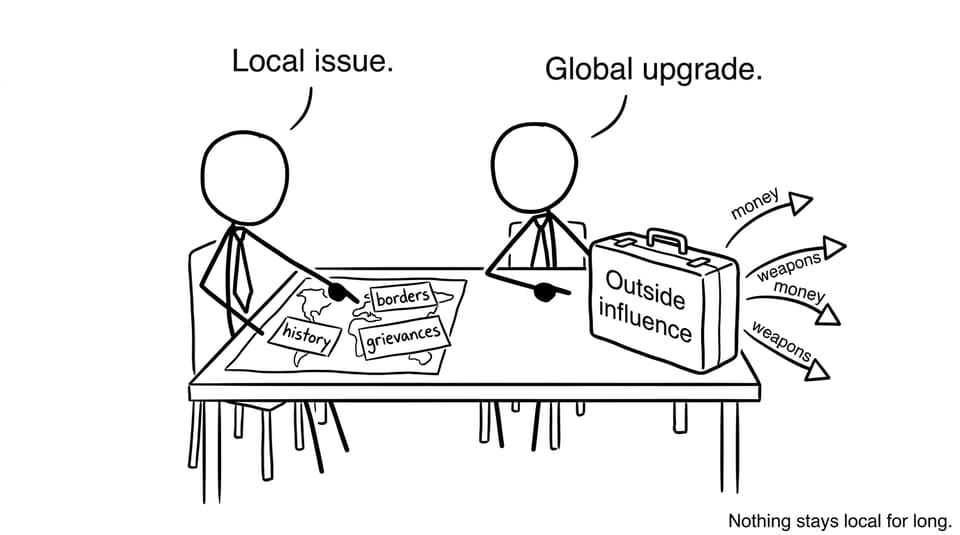
In IB Global Politics, this is where you show range: domestic and international causes aren’t separate boxes. They overlap.
How to write this for IB Global Politics exams
Examiners reward “multicausal, connected, evaluated.” A strong approach:
-
Define conflict in one clean line.
-
Give 2--3 main causes.
-
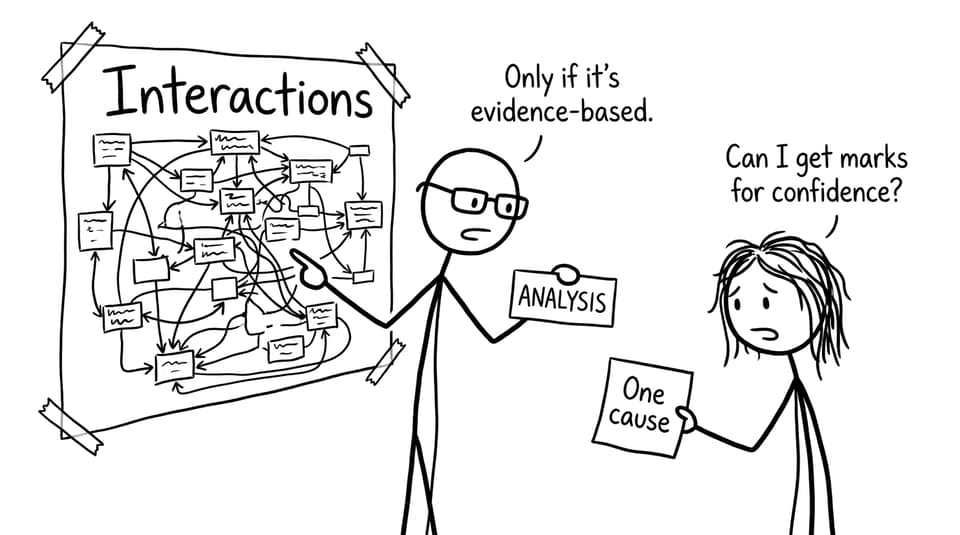
Show interaction (e.g., scarcity + exclusion + identity rhetoric).
-
Add a counterpoint: why conflict didn’t happen elsewhere, or why escalation wasn’t inevitable.
For timed practice, build sets from RevisionDojo’s exam guidance, like IB Global Politics Paper 1 Guide Notes and Notes for Paper 2 Guide.
Bringing it together
Conflict in IB Global Politics is best understood as a layered problem: power competition meets economic pressure, identity narratives, weak governance, historical memory, and external influence. Your job in exams is to make those links visible, then evaluate how and why escalation happens.
If you want a structured way to practise, use RevisionDojo’s Questionbank, Study Notes, and Flashcards, then test yourself with Mock Exams and Predicted Papers. When you write, run it through AI Chat and the Grading tools to see whether your argument is truly multicausal. That’s how IB Global Politics revision becomes less about panic, and more about control.