


Your IA rarely fails because you “don’t know enough science.” It fails because the story of your investigation is hard to follow. The experiment might be decent. The graphs might even be fine. But if the report doesn’t clearly show why you made choices, how your data answers the question, and what you’d fix next time, marks quietly leak away.
This guide breaks down the specific requirements for a Science IA (Biology, Chemistry, Physics, ESS-style investigations) so you can build something an examiner can trust.
Science IA requirements at a glance (save this)
Use this as a pre-submission checklist for your IA:
-
A focused, testable research question (RQ)
-
Background science that earns your hypothesis
-
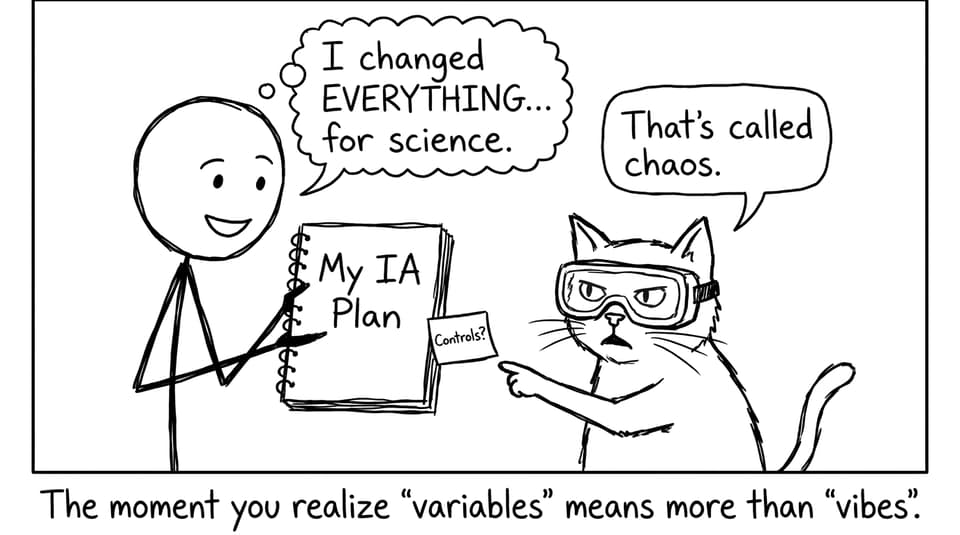
A method that is replicable (variables, controls, materials)
-
Enough raw data (with units, uncertainty, and repeats)
-
Processed data (calculations, graphs, trends, uncertainty)
-
A conclusion that answers the RQ using evidence
-
Evaluation: limitations, impact, realistic improvements
-
Clear communication and correct citations
If you want a broader rubric view, pair this with What IB Examiners Look for in a Strong IA.
The specific requirements for a Science IA (what examiners expect)
A research question that is narrow, measurable, and defendable
A strong IA starts with a question that forces numbers, not opinions. Define your independent and dependent variables clearly, ideally with units. “How does temperature affect enzyme activity?” is a start; “How does temperature (20-60°C) affect catalase activity measured by oxygen volume per minute?” is a usable plan.
Need inspiration that’s actually feasible? Browse topic lists like IB Biology IA Ideas: 2026 Topics That Actually Work or IB Chemistry IA Ideas in 2025.
An introduction that gives context (not a textbook dump)
Your introduction should do three jobs: set scientific context, justify the RQ, and lead naturally to a hypothesis (when appropriate). The requirement isn’t “write a lot”; it’s “show you understand the mechanism you’re testing.”
If you’re unsure what “enough” looks like, reading one high-quality sample can reset your standards. Start with Sample IB Biology IA: A Step-by-Step Example.
A method that someone else could replicate
This is a core Science IA requirement: an examiner should be able to picture your setup and repeat it. Include:
-
Variables (independent, dependent, controlled)
-
Materials with specifics (concentration, model, range, uncertainty)
-
Step-by-step procedure
-
Safety and ethical notes (even if brief)
-
A plan for repeats (reliability)
To sanity-check your design, use subject guides like IB Internal Assessment Guides (then match your structure to what your course expects).
Data collection that is organized and honest
Your IA data tables should show units, consistent decimal places, and measurement uncertainty. Collect enough data points to show a trend (and enough repeats to talk about variability). If you “know” what should happen but your data is messy, that’s not a disaster; it’s material for evaluation.
Analysis that connects calculations to the RQ
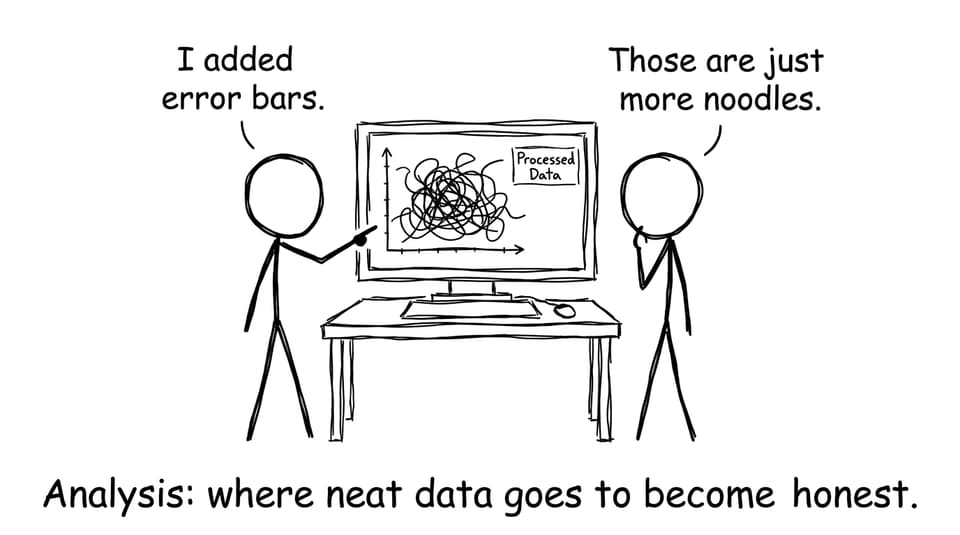
This requirement is where students either climb into the top bands or stall in the middle. Don’t just present graphs; explain what they show, why your processing is appropriate, and how uncertainty affects confidence.
RevisionDojo helps here in a very practical way: you can drill the skills that show up in analysis (units, sig figs, uncertainty, interpreting trends) using the Questionbank, then clarify confusing steps with AI Chat while you write.
Evaluation that admits limitations and proposes real improvements
A high-scoring Science IA doesn’t pretend the investigation was perfect. It explains specific limitations, their impact on results, and realistic improvements (not “use better equipment” unless you name what and why). This is also the place to discuss anomalies and whether your method truly tested what you claimed.
To tighten your self-marking, use rubric tools like the IB Biology IA Grader, IB Chemistry IA Guide, or IB Physics IA Rubric Explained.
Quick RevisionDojo workflow for your IA (fast but effective)
-
Use Study Notes to strengthen the science behind your hypothesis.
-
Use Flashcards to lock in definitions (uncertainty, reliability, validity).
-
Use AI Chat to pressure-test your research question and variables.
-
Use Grading tools (IA graders) to find rubric gaps before submission.
-
Use the Coursework Library to compare against strong exemplars.
-
If you’re stuck, ask Tutors for targeted feedback on one section at a time.
Final takeaway: treat the IA like a scientific argument
A Science IA is not a scrapbook of steps. It’s an argument that your question was worth asking, your method was fit for purpose, your analysis was careful, and your conclusion matches the evidence.
If you want to make that process faster (and less stressful), build your IA with RevisionDojo open in another tab: use the IA Guides, practice weak spots in the Questionbank, and run a final rubric check with subject graders before you submit.