


The night before an IB exam, most students do the same thing: they read more.
Not because it works best, but because it feels safe. Reading looks like progress. It sounds like learning. And yet, the IB doesn’t hand out marks for effort. It hands out marks for evidence, visible proof that you did the thinking the question demanded.
That’s what IB marking criteria really are: a map of what “proof” looks like.
The IB marking criteria in one sentence
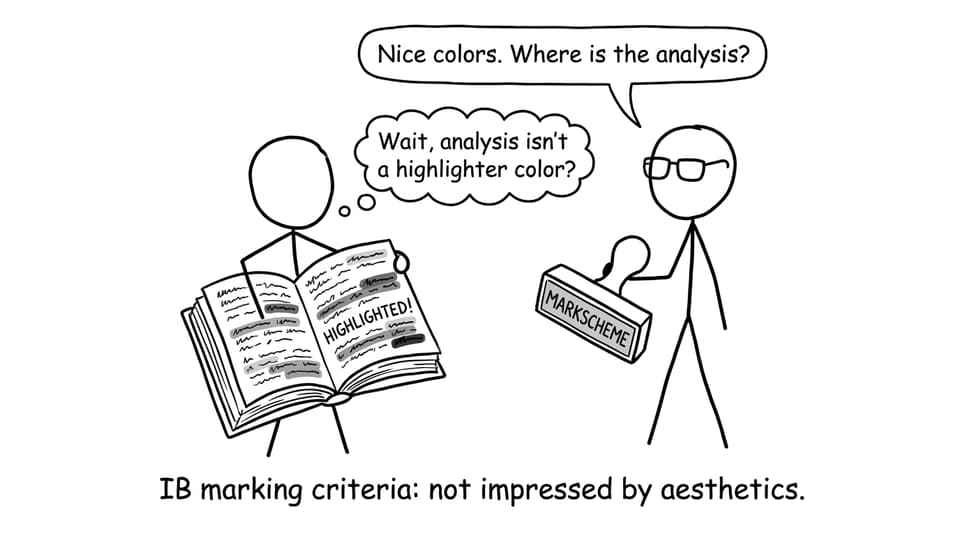
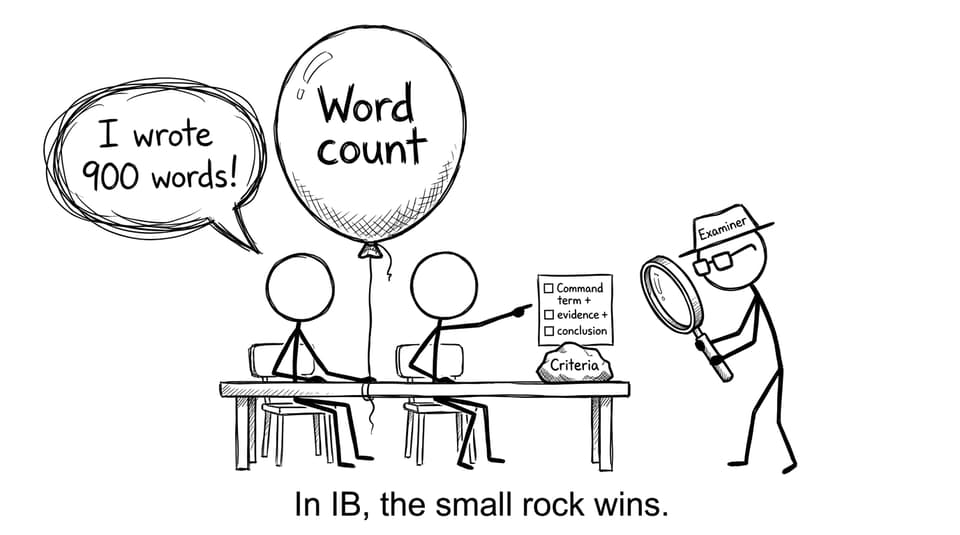
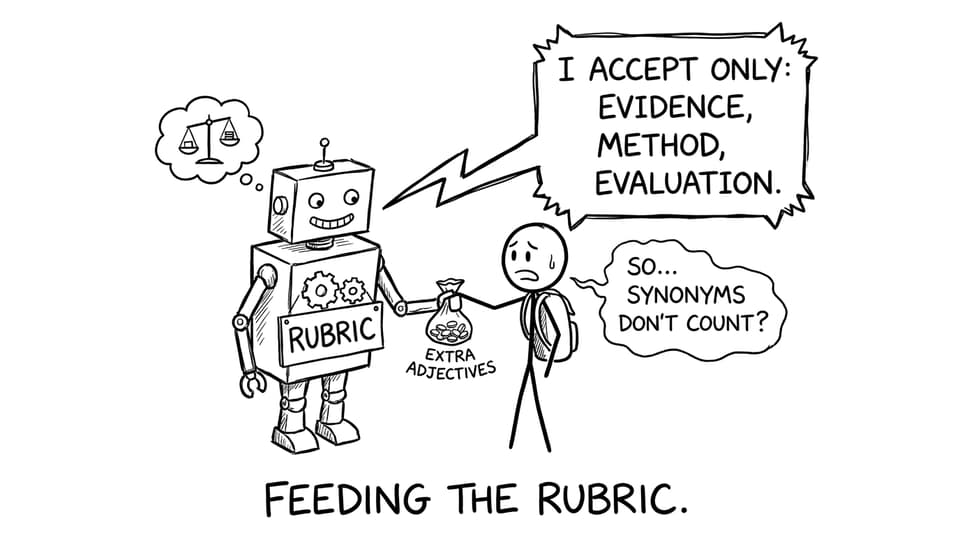
The IB rewards what an examiner can point to in a markscheme or rubric: the right command-term response, clear structure, precise subject language, and evidence (data, quotes, examples, method).
If you want the deeper logic behind how marks are actually awarded, pair this article with How IB Exams Are Marked (Use It to Your Advantage) and Structure IB Answers to Maximize Marks.
A quick IB checklist before you write anything
Use this mini routine across IB subjects:
-
Circle the command term.
-
Read the marks and translate them into “how many distinct points do I need?”
-
Choose the answer shape (bullets, PEEL paragraph, calculation with working, mini-essay).
-
Write in markscheme units: one idea per sentence or bullet.
-
Add proof: quote, data trend, case study, definition, method step, or labeled diagram.
-
Finish with a link back to the question (especially for evaluate/discuss/to what extent).
To build this into muscle memory, drill command terms using How to Use Command Terms Effectively in IB Exams and The Importance of Understanding Command Terms in IB Exams.
What IB examiners look for across every subject
Command terms: the invisible scoring rules
In the IB, the content is the topic. The command term is the deliverable.
“Define” wants precision with tight boundaries. “Analyze” wants parts plus relationships. “Evaluate” wants criteria, balance, and a justified judgement. If you give an “explain” answer to an “evaluate” question, you can write a lot and still score low because you didn’t do the job you were hired to do.
A strong habit is to rewrite the command term in your own words at the top of the page. It takes three seconds. It can save seven marks.
Structure and clarity: make the marks easy to award
Examiners are trained to reward what’s easy to find.
That’s why clear signposting matters in IB answers. If your paragraph has one purpose, claim, evidence, explanation, link, the marking becomes almost automatic. If your writing is a fog of good ideas, the examiner can’t “prove” you met the criteria.
For essay-heavy subjects, you’ll see this same principle everywhere, including IB English. If that’s you, keep a home base open like IB English A Lang & Lit Resources and use IB English Study Techniques That Actually Work to align practice with the rubric.
Evidence: show, don’t suggest
In IB marking criteria, evidence is not optional decoration. It’s the engine.
In sciences it might be data handling, uncertainty, or a labeled diagram. In humanities it’s a case study and a line of reasoning. In English it’s a quote and an effect. The examiner isn’t asking, “Do they sound smart?” They’re asking, “Did they support the point in a way the rubric recognizes?”
How marking criteria shift by subject (without changing the core rules)
IB English: interpretation with proof
For IB English, the best answers feel simple: a clear thesis, a small set of techniques, and consistent commentary tied to evidence.
If you need quick structure support before timed writing, use English A Lang & Lit Cheatsheets. They’re useful for revision because they keep terminology and analysis moves ready to deploy.
IB Sciences: method, data, evaluation
In IB sciences, marks often come in steps: method marks, processing marks, then evaluation.
That’s why “show your working” is more than a teacher phrase. It’s a scoring strategy. Build practice around official-style questions and feedback loops using RevisionDojo’s Questionbank, then pressure-test it with Mock Exams and Predicted Papers.
If you want a starting hub, try IB Physics Resources (the pattern applies across Biology, Chemistry, and Physics).
IB Mathematics: communication of reasoning
In IB math, you’re marked on what you did, not just what you reached.
Write down the method. Keep algebra readable. Use correct notation. A final answer with missing reasoning is often worth less than a wrong answer with excellent working.
For topic-based revision, start at IB Mathematics Analysis and Approaches Resources and use structured practice to build consistency.
Coursework (IAs, EE, TOK): criteria are the project
Coursework in the IB can feel personal, because you made it. But the marking criteria are still impersonal.
A strong IA or EE isn’t “interesting.” It’s focused. The research question is specific. The method is justified. The analysis does real work. The evaluation admits limitations without collapsing into apology.
This is where RevisionDojo becomes more than a study site. The Coursework Library helps you see what “top-band” looks like, and the Grading tools help you compare your draft to criteria without guessing.
How to train for IB marking criteria with RevisionDojo
Marking criteria become easier when your practice environment behaves like the examiner.
-
Use the Questionbank to practice exam-style questions by topic and command term.
-
Use Study Notes to learn the examinable version of the content (fast, structured, and aligned).
-
Convert weak points into Flashcards so definitions, processes, and case studies stay available under pressure.
-
When you get stuck mid-session, use AI Chat to clarify the one missing link instead of rereading a chapter.
-
Use Predicted Papers and Mock Exams to rehearse timing and stamina.
For a broader workflow, see RevisionDojo App: The Smarter Way to Prep for IB Exams.
Closing: make the IB criteria your unfair advantage
The students who score highest in the IB aren’t always the ones who know the most.
They’re the ones who understand the marking criteria well enough to make their thinking visible. They answer the command term. They structure for the examiner. They bring proof.
If you want that to become your default, build your practice loop on RevisionDojo: Study Notes for clarity, Flashcards for recall, Questionbank for markscheme-aligned practice, AI Chat for quick fixes, and Predicted Papers plus Mock Exams for realism. Learn the criteria once, then let it guide every answer you write in the IB.