
When students say they’re “choosing a level,” they usually mean a timetable choice.
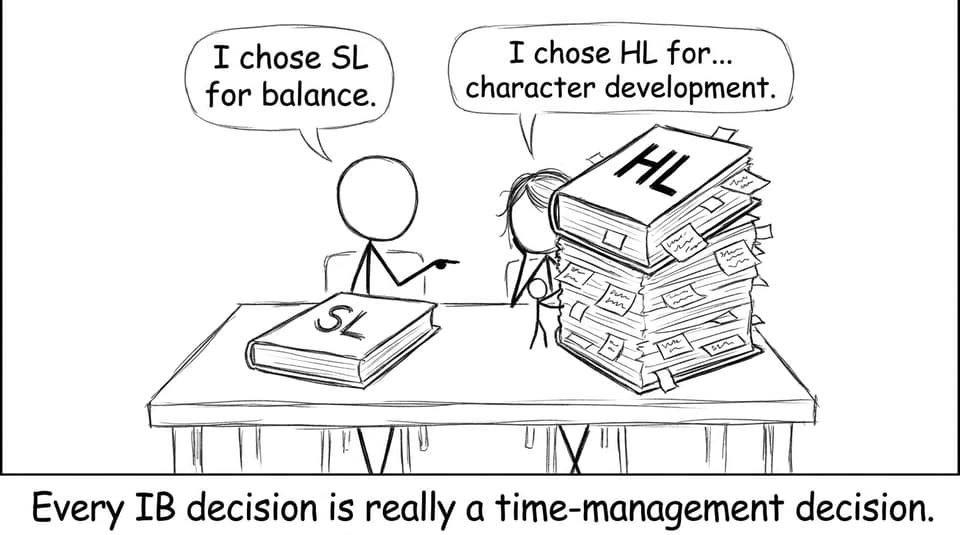
But IB Business Management has a funny way of turning timetable choices into identity choices: Am I the student who wants breadth and balance, or the student who wants depth and pressure? Neither answer is morally superior. They just lead to different days in March.
This guide walks you through the real differences between IB Business Management SL and HL: what you study, how you’re assessed, and what kind of practice actually moves your grade.
IB Business Management SL vs HL: the quick checklist
Use this as your 60-second filter before you commit.
-
Same core topics, but HL goes deeper and expects sharper evaluation.
-
HL has an extra exam paper (Paper 3).
-
Internal assessment is longer at HL and typically more research-heavy.
-
HL timing is tighter: longer papers, more sources, more decisions per minute.
-
Your best choice depends on your interest, writing stamina, and overall HL load.
If you want a home base for the whole course (SL or HL), start with IB Business Management Resources.
Curriculum differences in IB Business Management SL vs HL
Both levels study the same six core areas: organization and environment, HR, finance and accounts, marketing, operations, and strategy.
The difference is not the headings. It’s the weight of the thinking underneath them.
What SL focuses on
In IB Business Management SL, your job is to show you can:
-
explain key concepts clearly,
-
apply tools to a case context,
-
analyze cause and effect,
-
and reach a sensible, justified judgement.
SL is often a better fit if you like the subject but also want space for other demanding courses. Many SL students score very highly because they spend less time collecting “more content” and more time perfecting exam technique.
A smart way to build that technique is to drill short responses and structure by marks. This post helps: IB Business Management Marks Format Explained.
What HL adds
In IB Business Management HL, you still do everything above, but examiners expect:
-
more precise terminology,
-
more developed chains of reasoning,
-
more quantitative confidence,
-
and more balanced evaluation (trade-offs, stakeholders, feasibility).
HL can feel like SL with the volume turned up. Not louder content. Louder expectations.
If you’re revising Paper 1 style terminology and application, this is useful: Abraca (ABC) Terminology in IB Business Management.
Assessment differences: papers and timing
The easiest way to feel the SL vs HL difference is to imagine the exam room.
External assessment at SL
In IB Business Management SL you typically sit:
-
Paper 1 based on a pre-released case study (structured questions)
-
Paper 2 with structured and extended responses across the syllabus
Your biggest lever is learning to move from definition to application fast. If you regularly underperform on 10-mark responses, study the rubric like it’s a map: Understanding the IB Business Management 10 Marker Rubric.
External assessment at HL
In IB Business Management HL you sit:
-
Paper 1 (longer, more demanding, includes extended response)
-
Paper 2 (longer, deeper evaluation expected)
-
Paper 3 (HL-only)
Paper 3 is where students learn the real meaning of “recommend.” Not describe. Not list. Recommend with trade-offs.
For the HL Paper 3 decision-style response, use: Writing a Business Plan for the IB Business Management Paper 3 17 Marker. (Despite the title, it’s about structuring the 17-marker response.)
IA differences: what changes from SL to HL
The internal assessment is where your relationship with IB Business Management becomes personal, because it’s your chosen business issue, your analysis, and your ability to write like a calm consultant.
SL IA (commentary style)
At SL, the IA is typically a shorter written commentary (max 1,500 words) on a real business issue using business tools.
The main risk is not “not enough information.” The main risk is writing a mini-encyclopedia instead of a focused argument.
HL IA (research report style)
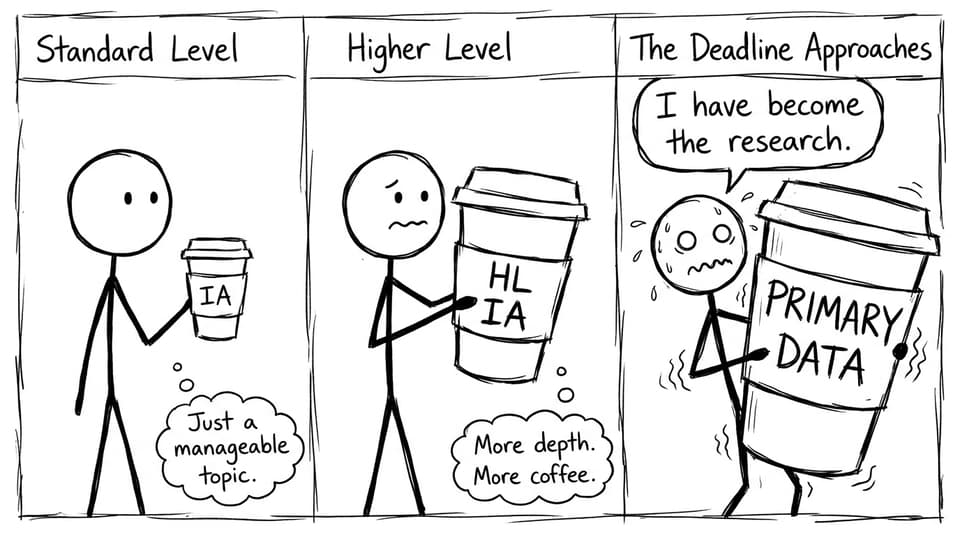
At HL, the IA is typically a longer research-based report (max 2,000 words) and often involves more formal data collection and analysis.
The main risk is not the word count. It’s scope creep: choosing a question so big you spend weeks gathering data, then rush the evaluation.
If you want models of what strong coursework looks like, use IB Business Management Exemplars and pair it with the IB Business Management Internal Assessment Guide.
Skill differences: what HL is really training you to do
A useful mental model: SL trains you to be a clear analyst. HL trains you to be a careful decision-maker.
SL skill emphasis
-
Clean definitions and accurate tools
-
Clear application to case details
-
Logical analysis without overcomplication
-
Time management across shorter papers
HL skill emphasis
-
Stronger evaluation and stakeholder judgement
-
More integrated use of tools and data
-
Better written control under longer papers
-
Comfort making recommendations with uncertainty
If you’re deciding between subjects, this comparison can help you calibrate fit: Is IB Business Management Easier Than IB Economics?.
How to choose SL or HL (without guessing)
Here are three questions that usually reveal the right answer.
Do you like the subject enough to live in it?
HL in IB Business Management rewards curiosity. If you enjoy reading a case and thinking, “What would I do if this were my company?” HL will feel energizing. If the case feels like a wall of text you have to climb, SL may keep you strong without draining you.
Can you sustain writing and evaluation under time?
HL is not “harder because more content.” It’s harder because you must evaluate more often, for longer, with better control. If your practice responses often stop at analysis and never reach a justified final judgement, HL will force that weakness into the open.
Is your overall diploma balanced?
HL is manageable when your schedule has breathing room. If you already have multiple heavy HLs, SL can be the strategic choice that protects your whole diploma.
If you want a system for turning practice into points, read: How to Maximize Your Score in IB Business Management.
How RevisionDojo helps SL and HL students build exam-ready confidence
The biggest trap in IB Business Management is believing that reading notes equals progress. Progress is being able to answer under constraints.
RevisionDojo is built around that reality:
-
Questionbank to practice by topic and difficulty, not by hope.
-
Study Notes and Flashcards for fast recall of tools and definitions.
-
AI Chat to turn weak topics into focused drills and mini case prompts.
-
Grading tools to get rubric-aligned feedback on 10-mark and HL-style responses.
-
Predicted Papers and Mock Exams to rehearse timing and decision-making.
-
Coursework Library and Tutors when you need examples or expert guidance to stay on track.
Final thought: choose the level that lets you practice well
The honest difference between SL and HL in IB Business Management is this: HL rewards depth, SL rewards precision. Both reward practice.
If you want to turn revision into predictable marks, build your routine in RevisionDojo: start with the Questionbank, reinforce with Study Notes and Flashcards, then pressure-test with Mock Exams and Predicted Papers. And when you’re stuck, use AI Chat, the Grading tools, and Tutors to keep moving.
Your level choice matters. Your practice habits matter more.