
If you have even a mild interest in money, markets, or entrepreneurship, there’s a moment in IB where two doors appear side by side.
One says Business Management.
The other says IB Economics.
And the question isn’t just “Which one?” It’s the more tempting, more dangerous version: “Should I take both?”
For some students, the combo feels like doubling down on what they already like. For others, it becomes the silent reason revision starts late, essays stay half-finished, and exams feel like a sprint with no warm-up.
The quick decision checklist (save this)
Before you commit to Business + IB Economics, run these checks:
-
Can you take two Group 3 subjects at your school (often by replacing a Group 6 subject)?
-
Do you genuinely enjoy both types of thinking: business frameworks and economic models?
-
Are you prepared for more writing under time pressure?
-
Are your other subjects already heavy (HL Math, HL sciences, languages)?
-
Do you have a revision system (Questionbank, notes, flashcards, timed practice) ready from month one?
If you want the rule-and-reality version of whether it’s even possible, read: Is it possible to take both IB Business Management and IB Economics?
Why Business and IB Economics feel similar (but test different skills)
On the surface, Business and IB Economics share a vocabulary: firms, competition, pricing, growth, globalization. That overlap is real, and it can help.
But the exam reward system is different.
Business often asks: Given this company, what should it do? Your job is to apply tools, use the case context, and make a recommendation.
IB Economics asks: Given this policy or market outcome, why did it happen, and what are the trade-offs? Your job is to use theory, diagrams, real-world evidence, then evaluate.
If you want a clean comparison before choosing, these two are worth keeping open in tabs:

The upside of taking both (when it works)
You build “inside the firm” and “outside the firm” thinking
Business trains you to see decisions inside an organization: stakeholders, finance constraints, operations, strategy. IB Economics trains you to see the environment around it: incentives, market failure, macro goals, trade-offs.
Together, you start writing answers that feel more adult. Not longer. Clearer.
Universities tend to understand the combination
The pairing can signal focus: you’re interested in commerce, policy, finance, or entrepreneurship, and you can handle both structured analysis and practical application.
For the admissions angle, read: Taking both IB Economics and Business: what universities think
Revision overlaps in useful ways (if you plan it)
Some topics reinforce each other: market structures, competition, globalization, ethics, government intervention.
The trick is to use overlap to save time, not create redundancy. That means one set of core definitions, one bank of real-world examples, and targeted practice by paper style.
The downside (what students underestimate)
The workload isn’t just “two subjects”
It’s two different exam languages.
In Business you’re rewarded for sharp application to the case and recommendation quality. In IB Economics you’re rewarded for diagram accuracy, chain reasoning, and balanced evaluation.
If your schedule is already full, the risk isn’t failing. It’s scoring slightly below your potential in both.
Overlap can become confusion
Students sometimes blend frameworks: writing business-style recommendations in IB Economics, or using economic diagrams where the business rubric wants contextual judgment.
Knowing the boundary is part of scoring well.
Burnout shows up late
You won’t feel it in week three. You’ll feel it when multiple deadlines land, mocks start, and every subject demands “just one more timed paper.”
How to make the combo manageable (exam-focused)
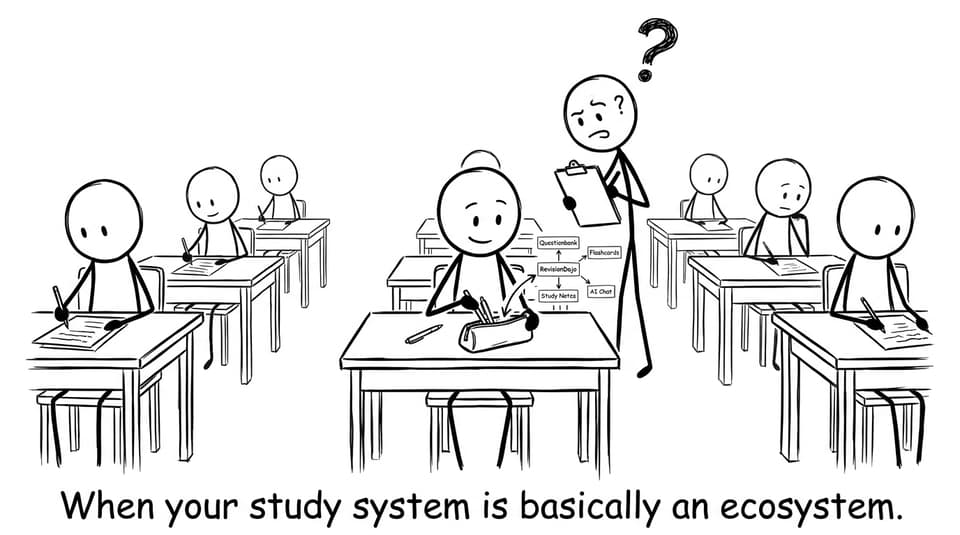
If you take both, treat revision as an engineering problem: build a system that reduces friction.
-
Use the IB Economics Resources hub for structured Study Notes, Flashcards, and a Questionbank that matches the syllabus.
-
Pair it with the Business Management resources hub so your Business practice stays rubric-accurate.
-
Use AI Chat to test definitions, generate quick essay plans, and pressure-test evaluation points.
-
Use Grading tools to spot the same leaks you repeat under timed conditions.
-
Add Mock Exams and Predicted Papers when you need stamina, not more theory.
For skill-specific boosts:
The decision to make (and the mistake to avoid)
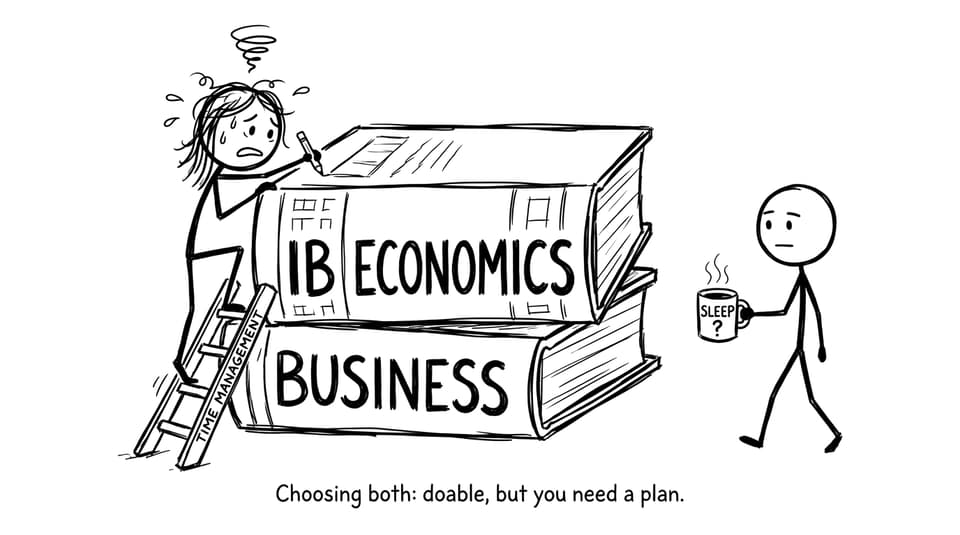
Taking Business and IB Economics can be a smart, coherent combination. It can also be the quiet choice that overloads your schedule if you treat it like “two similar subjects” instead of “two different exam games.”
If you choose both, choose the system too: a place where your Questionbank practice, Study Notes, Flashcards, AI Chat, Grading tools, Predicted Papers, Mock Exams, Coursework Library, and Tutors all pull in the same direction.
Build that once, and IB Economics stops feeling like a second mountain. It becomes the second viewpoint that makes the whole landscape finally make sense.