




If you have ever listened back to your own track and thought, It sounds fine… but will it score? you are already thinking like a strong IB Music student. In IB Music, composition is not graded like a talent show. It is graded like a story told with evidence: musical decisions you can point to, explain, and defend.
This guide breaks down how IB Music composition is assessed, what moderators are really checking for, and how you can build pieces that feel personal and examiner-friendly.
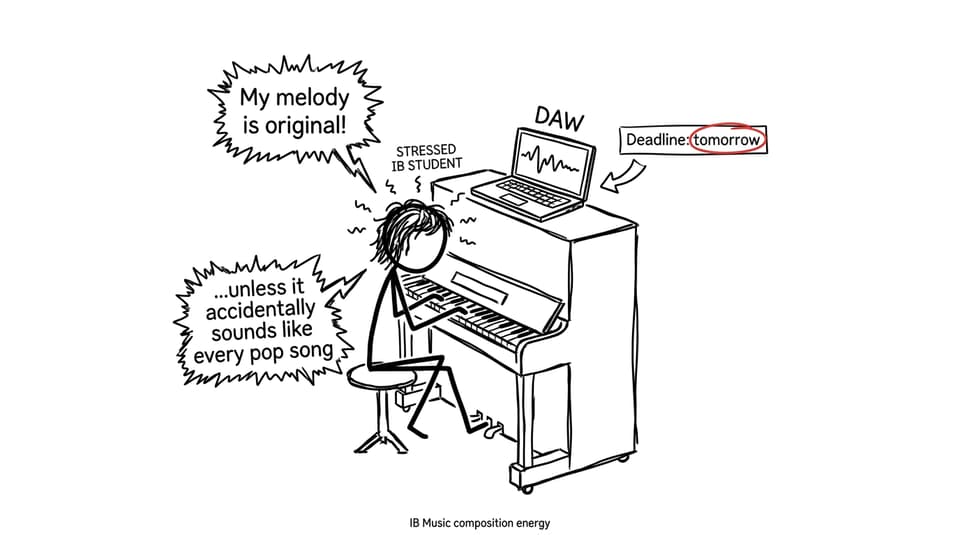
IB Music composition: what you are really being assessed on
Composition in IB Music sits inside “Creating Music,” where your goal is to produce original work and show you understand how it works. That means your composition is evaluated on two layers at once:
-
The music itself (ideas, craft, structure)
-
The thinking behind it (reflection, context, process evidence)
If you want a bigger picture of how this fits into your overall grade, read How IB Music Is Graded: Assessment Components Explained.
Quick checklist before you export your final audio
Use this short checklist to keep your IB Music composition aligned to the criteria:
-
One clear musical idea introduced early (motif, groove, texture concept)
-
Development techniques you can name (variation, fragmentation, inversion, modulation, reharmonization)
-
A form the listener can follow (ABA, rondo, verse-chorus, through-composed with clear sections)
-
Technical control of melody, harmony, rhythm, texture, and timbre
-
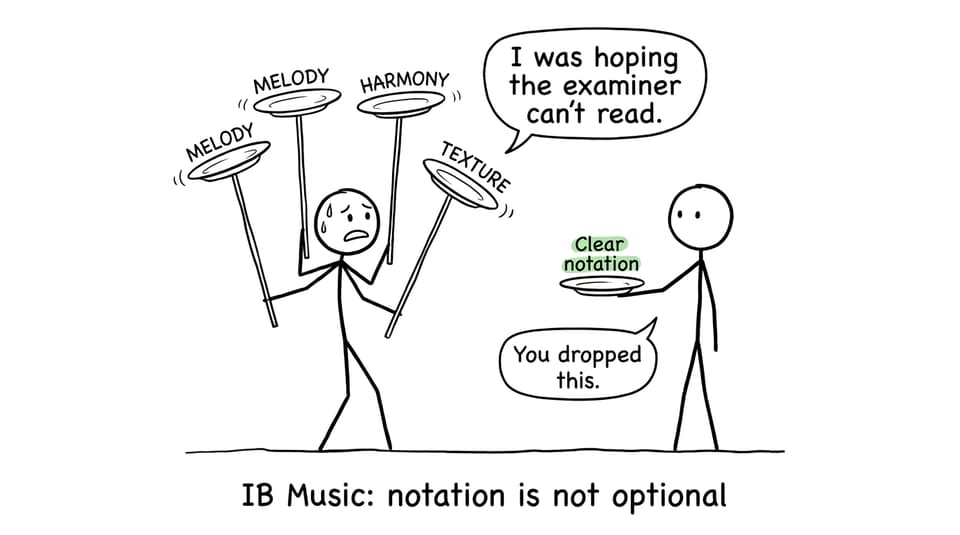
Clear notation or production documentation (so the examiner can see the craft)
-
A reflection that explains decisions, influences, and revisions
For a deeper workflow, borrow the structure in How to Compose Music for IB Music Coursework.
What examiners reward in IB Music compositions
A useful way to think about IB Music assessment is: examiners are listening for intention. Not perfection. Intention.
Creativity and originality (but not “randomness”)
In IB Music, originality is not about inventing a new genre. It is about making choices that sound like you. Examiners reward risk when it is controlled.
Practical ways to show this:
-
Start with a familiar influence, then transform it (change meter, reharmonize, shift instrumentation)
-
Use constraints (only pentatonic material, only quartal harmony, only additive rhythm) to create identity
-
Create contrast: if your A section is dense, make B spare and deliberate
If you want a clear list of what top-band work tends to show, use What Examiners Look for in IB Music Compositions.
Technical proficiency: make the craft obvious
Great IB Music composition is often “simple but intentional.” You score well when you demonstrate control of musical elements:
-
Melody: phrasing, contour, motivic development
-
Harmony: purposeful progressions, cadences, color tones, modulation (if used)
-
Rhythm: pulse stability, variation, rhythmic identity
-
Texture and timbre: layered thinking, not just “everything at once”
-
Notation/production clarity: readable, consistent, and complete
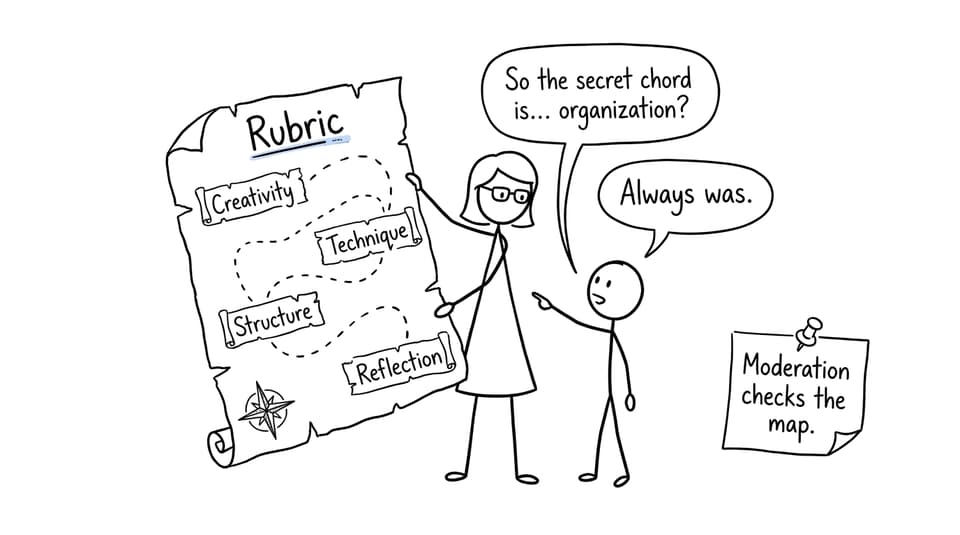
Structure and coherence: your piece needs a roadmap
Many IB Music compositions lose marks not because the ideas are weak, but because the listener cannot tell where they are in the journey.
To fix that, make structure audible:
-
Mark sections with texture changes, cadences, register shifts, or new rhythmic layers
-
Repeat your main idea enough that it becomes a reference point
-
Develop in a traceable way: one change at a time beats five changes at once
If you struggle to connect “Exploring” to “Creating,” see Best Ways to Link Performing, Creating, and Exploring in IB Music.
Reflection and moderation: the hidden score booster
In IB Music, your reflection is where you prove the composition was made on purpose. Write it as a calm explanation of your decision-making:
-
What influenced you (style, culture, composer/producer techniques)
-
What problems you faced (balance, transitions, harmonic dullness)
-
What you changed across drafts (with brief evidence)
-
What you learned (musical growth, not generic motivation)
Remember: your teacher marks first, then external moderation checks consistency. So clarity protects you.
How RevisionDojo helps you practice IB Music composition smarter
The fastest way to improve IB Music composition is to shorten the feedback loop.
Use RevisionDojo like a studio routine:
-
Study Notes to patch theory gaps quickly
-
Flashcards for daily recall of techniques and vocabulary
-
Questionbank to train assessment thinking across IB subjects (and keep your study discipline consistent)
-
AI Chat to troubleshoot harmony, form, or reflection wording when you are stuck
-
Grading tools to pressure-test your commentary against criteria
-
Predicted Papers and Mock Exams to stay exam-ready in your other subjects
-
Coursework Library and Tutors when you need examples and targeted feedback
If you want an overall study system that actually survives busy weeks, read You're Not Lazy: Your IB Study Method Is Broken.
Conclusion: make your IB Music composition easy to reward
The best IB Music compositions do not beg for marks. They make marks feel inevitable. They sound intentional, they show craft, and they explain themselves with calm clarity.
If you want a reliable next step, build one composition “feedback loop” this week using RevisionDojo: Study Notes for quick theory fixes, Flashcards for daily technique recall, AI Chat for fast troubleshooting, and Tutors when you need a second set of expert ears. Your music stays yours. The assessment becomes predictable.
For more IB Music support, browse All IB Music Posts and keep your composition work aligned with how it is actually graded.