


The night before a business exam, most students worry about forgetting a formula.
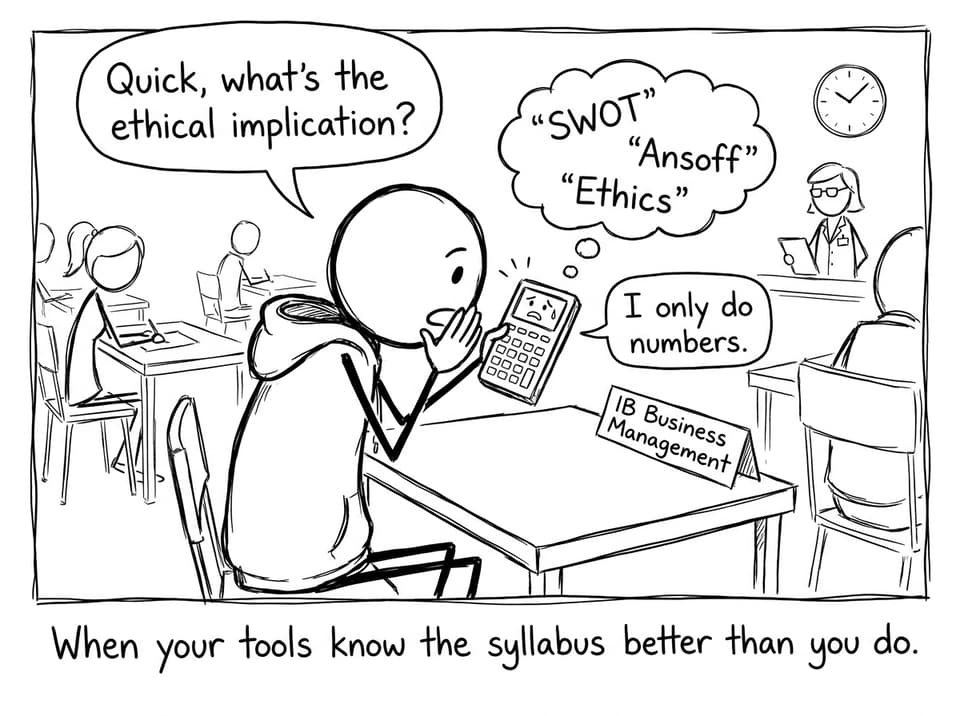
The quieter fear is different: What if my analysis looks smart, but it isn’t honest? What if you lean on a convenient statistic you can’t verify, copy a model paragraph that “sounds like an examiner,” or nudge your conclusion until it fits the recommendation you already wanted?
In IB Business Management, integrity is not a bonus virtue. It is the baseline of credible research, credible evaluation, and credible judgment. Examiners can tell when work is built on real evidence and balanced thinking, and they can also tell when it’s built on shortcuts.
This guide is a practical map for ethical decision-making and analysis in IB Business Management, for your exams and for your IA.
Integrity checklist for IB Business Management (fast, exam-friendly)
Use this as a pre-flight check before you submit an IA draft or commit to a Paper 1/Paper 2 argument.
-
Use real, verifiable business data (and keep the trail).
-
Cite every source you didn’t personally generate.
-
Never fabricate survey results, interview quotes, or financial figures.
-
Apply tools (SWOT, Ansoff, STEEPLE, Porter) to reach a conclusion, not decorate one.
-
Show balanced evaluation: benefits, costs, and stakeholder impacts.
-
Treat AI responsibly: support your learning, don’t outsource your thinking.
If you want one hub that connects tools, topics, and examiner expectations, start with the IB Business Management resources page.
What integrity means in IB Business Management analysis
Integrity in IB Business Management is not only “don’t plagiarize.” It’s a three-part habit:
Honest evidence
You use data you can explain, defend, and trace. If a number appears in your work, you should be able to answer: Where did it come from? When was it published? What might it be missing?
Honest tools
You choose a tool because it fits the decision. You don’t run a “tool parade” to look busy. A decision tree, break-even, or Ansoff matrix should change what you notice, not just fill space.
Honest judgment
You evaluate with trade-offs. You acknowledge uncertainty. You make recommendations that are conditional (“If X holds, then Y is viable”) rather than absolute (“This will definitely succeed”).
On RevisionDojo, the IB Business Management Internal Assessment Guide models this tone: evidence-led, tool-led, then judgment.
Ethical research: collecting data you can stand behind
For IB Business Management, strong research is simple in theory and demanding in practice: get information that is accurate, current, and relevant to the decision.
For secondary research
Use reputable sources (company reports, financial statements, major journalism, government databases). Then do the integrity move students skip: record the details while you research, not later.
Practical tip: keep a “source log” with three columns: claim, source, why it’s reliable/limited. That third column is where integrity turns into marks.
For primary research
Interviews, surveys, and observation can be powerful, but only if they are truthful and ethical.
-
Ask permission if required and respect confidentiality.
-
Avoid leading questions that force a desired result.
-
Don’t invent responses to “finish the dataset.”
If you’re building your IA, the blog post IB Business Management IA: Structure, Samples and Smart Tools is a strong companion for aligning evidence to the criteria.
The integrity traps students fall into (and how to avoid them)
Most misconduct is not dramatic. It’s quiet. It looks like stress management.
“Everyone uses this template paragraph”
If you copy phrasing from online examples, you risk crossing into plagiarism and you also lose the examiner’s trust. In IB Business Management, the highest marks come from application, not generic theory.
Solution: write one clean definition sentence, then immediately anchor it to the case or organization.
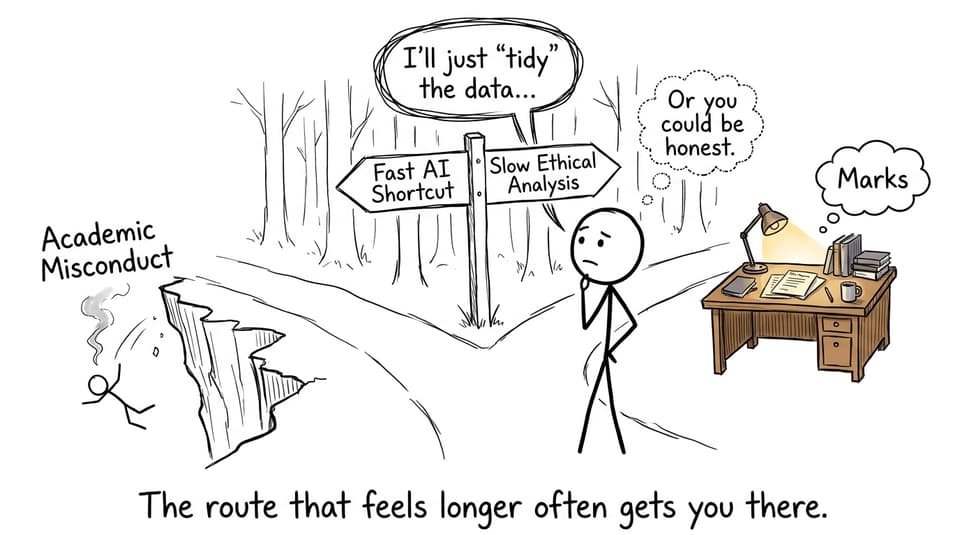
“I tweaked the numbers a bit so the recommendation works”
This is the most dangerous trap because it feels like “making the analysis clearer.” In reality, it reverses the logic. The data should shape your recommendation.
Solution: if your numbers create an awkward conclusion, keep it. Then evaluate: Is the decision still desirable? Under what conditions could it change?
“I used AI to polish and it became… not my writing”
If AI changes the thinking, structure, or wording beyond light assistance, your integrity is at risk.
Solution: use tools to study, not to substitute. On RevisionDojo, AI Chat can help you test understanding (for example, “Give me three stakeholder conflicts in this scenario and ask me to evaluate them”), while your final writing stays yours.
If you’re choosing an IA direction, How to Find a Strong IB Business Management IA Topic helps you pick a decision that is researchable without forcing fake certainty.
Ethical decision-making frameworks that make your evaluation sharper
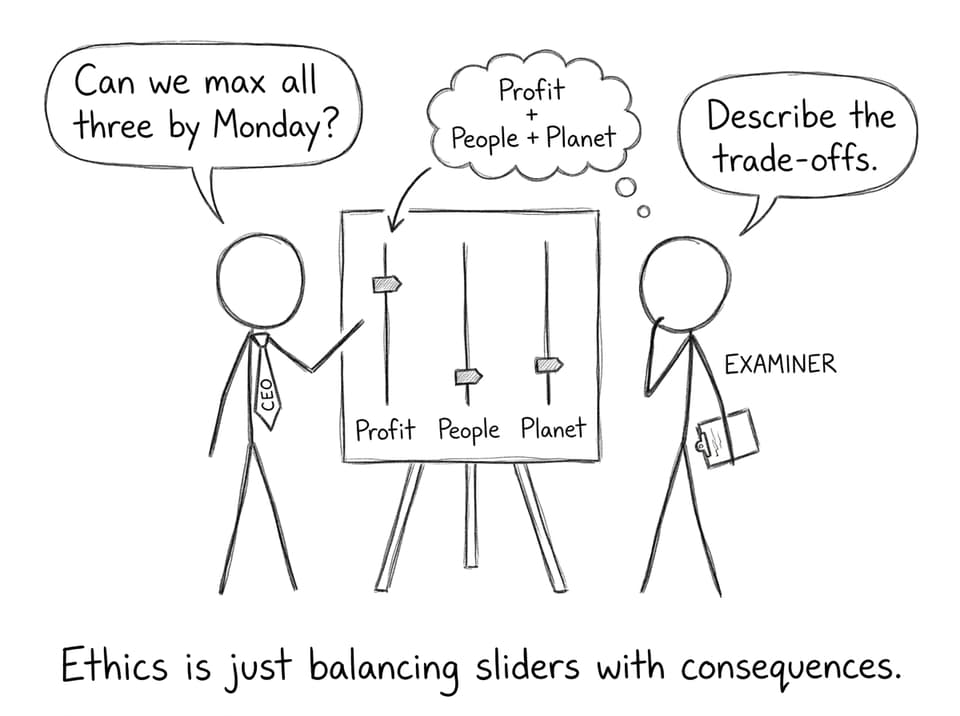
In IB Business Management, ethics becomes visible when you use a framework to structure trade-offs.
Stakeholder lens (who wins, who pays)
A recommendation that only talks about profit is usually incomplete. Consider employees, customers, local communities, suppliers, governments, and shareholders.
Your evaluation becomes stronger when you specify how each stakeholder is affected (wages, safety, price, quality, reputation, compliance risk) and when (short vs long term).
CSR and sustainability (what “responsible” actually costs)
Ethical choices often involve real costs: investment in cleaner processes, safer sourcing, better training, or more transparent reporting. Treat those costs as business variables, not moral decorations.
RevisionDojo’s topic coverage includes sustainability-linked content like Circular Business Models and syllabus sections that connect decisions to impact.
The tool-to-ethics bridge (turning models into responsibility)
Tools are not ethical by themselves. But they can reveal ethical consequences.
-
SWOT: integrity means you write real weaknesses, not flattering ones. Use RevisionDojo’s SWOT analysis notes to practice honest internal weaknesses and external threats.
-
Ansoff matrix: integrity means acknowledging risk levels. See Ansoff matrix notes for clean growth logic.
-
Investment appraisal: integrity means explaining assumptions (discount rate, cash flow reliability). Practice with Investment Appraisal (3.8).
And when you want to see how tools get used under real Paper 1 pressure, the IB Business Management 2026 case study summary (Abraca ABC) is a useful example of case-anchored thinking.
How to show integrity in exam answers (without writing an essay)
You don’t need long moral speeches. You need structured honesty.
A simple paragraph structure for IB Business Management
-
Define the concept briefly.
-
Apply it to the case (a specific detail).
-
Analyze consequences (financial and operational).
-
Evaluate using ethics/stakeholders (trade-offs).
-
Judge with conditions.
This structure is also how RevisionDojo’s Grading tools and Questionbank feedback tends to reward clarity: it’s easy to mark, and it’s hard to fake.
If you want to calibrate what a “good” mark outcome looks like, check the IB Business Management grade boundaries page to set realistic performance targets while you practice.
How RevisionDojo supports ethical, high-scoring IB Business Management prep
Integrity is easier when your workflow makes honesty the default.
-
Study Notes help you learn tools well enough to explain them in your own words.
-
Flashcards reinforce definitions so you don’t copy generic paragraphs under pressure.
-
The Questionbank builds exam instincts through volume and feedback: Questionbank.
-
AI Chat helps you test understanding ethically (you ask, you answer, it checks).
-
Grading tools help you see if your evaluation is balanced or one-sided.
-
Predicted Papers and Mock Exams build honest timing skills (no last-minute “miracle drafting”). Start here: IB Business Management predicted papers.
-
The Coursework Library helps you learn quality standards without copying, like these Business Management IA exemplars.
-
Tutors add human feedback when your argument is stuck.
For a broader exam workflow, the article RevisionDojo App: The Smarter Way to Prep for IB Exams shows how to combine these features into a repeatable loop.
FAQ: Integrity in IB Business Management
What counts as misconduct in IB Business Management?
Misconduct in IB Business Management includes plagiarism (copying wording or structure without citation), fabrication (inventing data, survey results, or interview quotes), and misrepresentation (presenting unverifiable claims as facts). It also includes using unauthorized help in ways that replace your own analysis, such as submitting AI-generated writing as if you wrote it. Many students misunderstand this and assume misconduct only means copying a whole document. In reality, small copied sections or “borrowed” analysis paragraphs can still trigger serious problems. The safest rule is simple: if you didn’t create it, you cite it; if you can’t verify it, you don’t use it. Integrity is both a compliance issue and a marks issue because untrustworthy evidence weakens evaluation.
How do I find reliable sources for my IB Business Management IA or case analysis?
Start with sources that have accountability: annual reports, official company statements, government data, and established business journalism. Then test reliability by asking: who published it, what incentives might they have, and how recent is it? In IB Business Management, “reliable” also means “relevant to the decision,” so avoid dumping pages of background that do not affect your recommendation. Save screenshots or PDFs of key tables in case links break and so you can show the evidence trail. When you cite, do it in a way that makes your research reproducible: title, organization, date, and where the claim appears. Finally, build in evaluation by stating limitations (for example, “company PR may present biased framing”), because acknowledging bias is part of integrity.
Do I need to include ethics in every IB Business Management answer?
You do not need to force ethics into every single sentence, but you should be ready to evaluate decisions through ethical implications when it matters. Many prompts in IB Business Management naturally involve stakeholder conflict, sustainability, labor practices, pricing fairness, or reputational risk. Ethics often becomes your evaluation advantage because it helps you weigh short-term profits against long-term viability and brand trust. Even when a question is mostly financial or operational, a single ethical evaluation point can raise the sophistication of your judgment. The key is relevance: link ethics to consequences (costs, compliance, customer loyalty, risk), not moralizing. If you practice this habit in timed conditions, it becomes a natural part of your exam voice.
Can I use AI tools at all while studying IB Business Management?
Yes, but you should use AI in a way that strengthens your learning rather than replacing it. For example, you can ask AI to quiz you on definitions, generate practice scenarios, or point out missing stakeholder groups in your plan. What you should avoid is having AI write your IA draft, craft your evaluation paragraphs, or generate “model answers” that you then submit. In IB Business Management, your marks come from how you apply tools to specific evidence and how you justify trade-offs. A good rule is: if the output is something you could submit for marks, you should be extremely cautious and follow your school’s policy. With RevisionDojo, the intent of AI Chat is to keep you in the driver’s seat by checking your understanding and helping you practice.
Closing: integrity is the strategy that holds under pressure
A business decision that only works when no one asks questions is not a strategy. It’s a story.
In IB Business Management, integrity is the difference between a story and an argument: evidence you can trace, tools you can explain, and evaluation that admits trade-offs. That’s what examiners reward. It’s also what real leaders rely on when outcomes are uncertain and stakeholders disagree.
If you want to build that kind of confidence, use RevisionDojo to practice the honest loop: learn with Study Notes, retain with Flashcards, apply with the Questionbank, refine with Grading tools, stress-test with Predicted Papers and Mock Exams, and get help from AI Chat, the Coursework Library, or Tutors when you need it. Start at the IB Business Management hub and turn integrity into your competitive advantage.