



Every IB student has had the same moment: you read a paragraph three times, understand it… then it evaporates the second you close the book.
If you’re a visual learner, this isn’t a motivation problem. It’s a format problem. Your brain wants shape, contrast, and structure. It wants information you can see.
This guide turns IB revision into something more visual, more memorable, and more realistic for exam conditions. You’ll get techniques you can use tonight, plus tools inside RevisionDojo that make visual learning feel less like “pretty notes” and more like marks.
The IB visual revision checklist (save this)
When you revise for IB as a visual learner, aim for a simple loop:
-
Compress a topic into one view (mind map, one-page sheet, flowchart)
-
Label with exam language (definitions, variables, command terms)
-
Test yourself from the visual (cover-and-recall, redraw, explain)
-
Apply with exam-style questions (so the visuals convert into scores)
-
Fix weak spots using feedback, then update the visual
RevisionDojo supports this loop naturally: use Study Notes to understand, Flashcards to remember, Questionbank to apply, AI Chat to get unstuck, Grading tools to improve written responses, and Mock Exams plus Predicted Papers to rehearse under time pressure.
Why visual learning works for IB (when you use it correctly)
Visual learning works because it reduces “floating information.” Instead of holding ten disconnected facts in your head, you build a map where each idea has a location.
But IB exams don’t reward decoration. They reward accurate recall under pressure and clear application. The best IB visuals do two things at once:
-
They show relationships (cause/effect, steps in a process, comparisons)
-
They make it easier to retrieve exact phrasing (key terms and definitions)
If your diagram looks amazing but you can’t answer questions afterwards, it’s art, not IB revision.
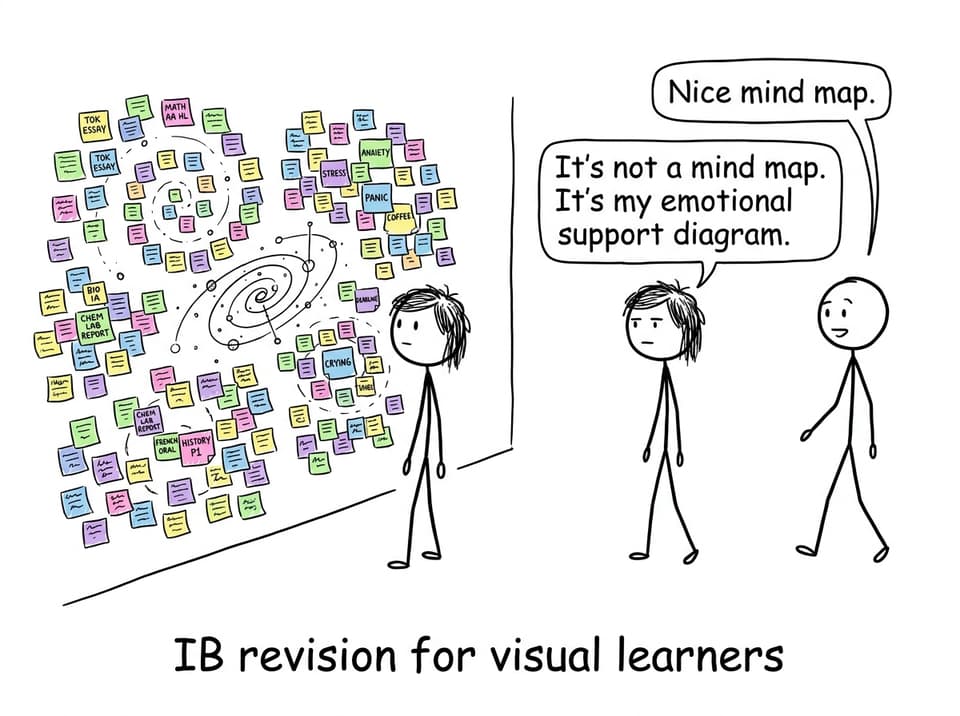
IB mind maps that actually improve memory
Mind maps are powerful for IB subjects with lots of connections: Biology pathways, History causes and consequences, Economics policies and outcomes.
To make a mind map exam-useful:
-
Put one syllabus idea in the center (not an entire unit)
-
Use 3-5 branches max (so it stays readable)
-
Add one image or symbol per branch (tiny, quick, memorable)
-
Write trigger words, not paragraphs
If you want examples of the visual-first approach, start with RevisionDojo’s post on IB revision for visual learners and pair it with visual IB study materials.
Turn mind maps into marks with a 2-minute test
-
Look at your map for 20 seconds.
-
Cover it.
-
Recreate it from memory (roughly).
-
Circle what you missed.
That last step is the whole point. Your “missed circles” become tomorrow’s Flashcards.
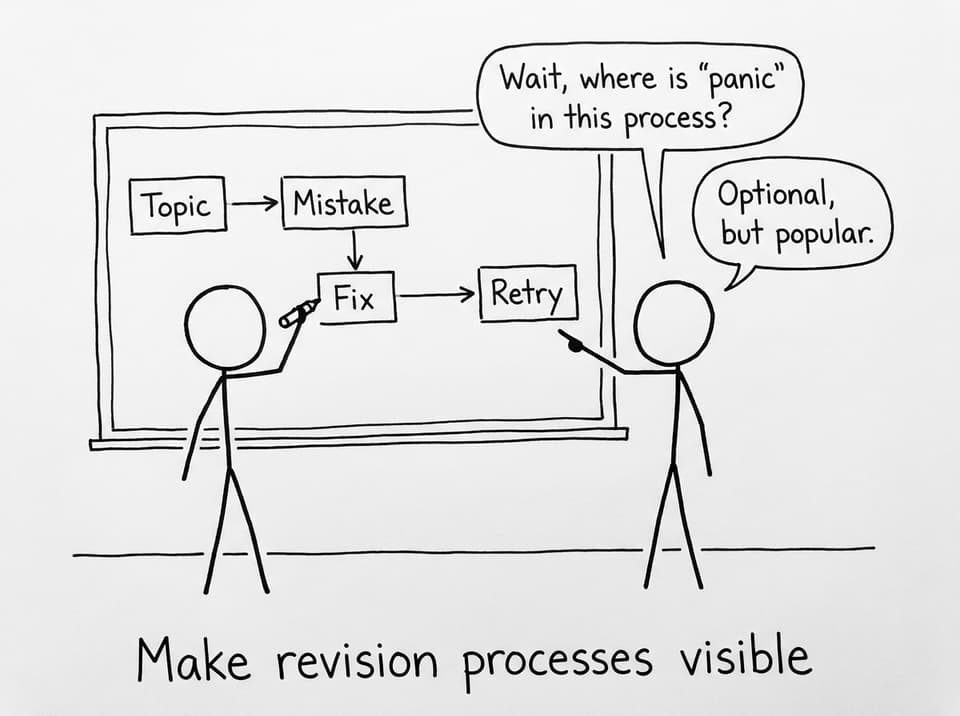
IB diagrams and flowcharts for processes (sciences + beyond)
Flowcharts are the visual learner’s shortcut for anything sequential: lab methods, biological processes, math procedures, TOK argument structure.
A high-scoring IB flowchart uses:
-
Arrows with verbs (“diffuses”, “increases”, “inhibits”)
-
Inputs/outputs (what goes in, what comes out)
-
Common mistakes in a side box (“Don’t confuse X with Y”)
Then you pressure-test it with questions. Use the RevisionDojo Questionbank feature to drill the exact topic until the flowchart becomes automatic.
IB flashcards for visual learners (make recall visible)
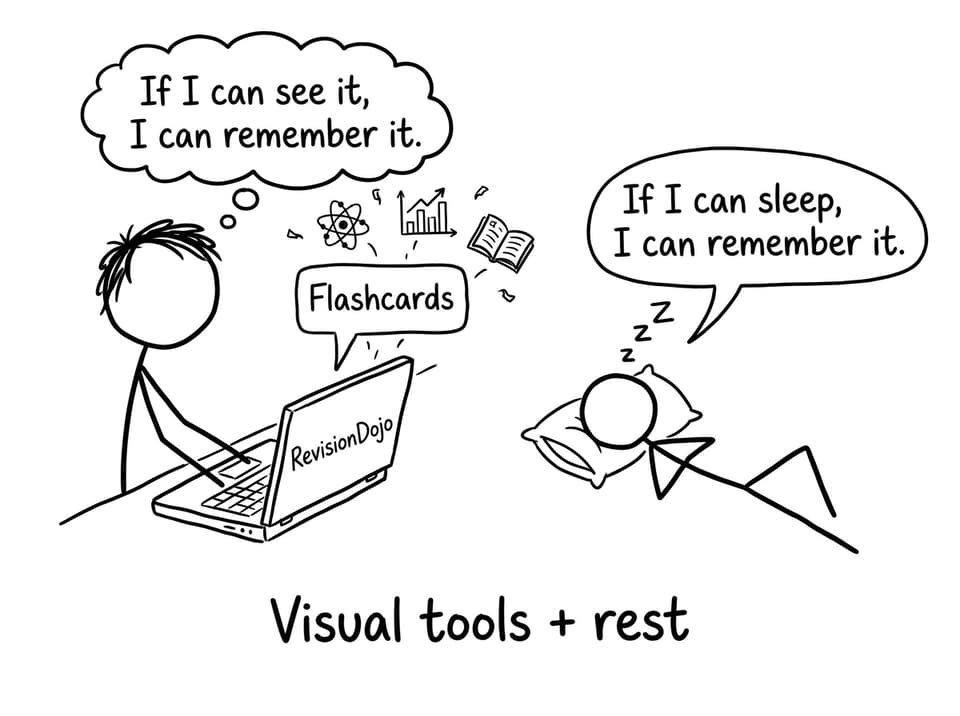
Flashcards are often described as a memory tool. For visual learners, they’re also a design tool: each card forces you to decide what the concept looks like.
Three upgrades that work במיוחד well for IB:
-
Add a mini diagram (even a messy one)
-
Use color rules (e.g., red for errors, blue for definitions)
-
Create compare cards (“X vs Y” tables are visual gold)
RevisionDojo’s IB Flashcards with spaced repetition are built for daily recall, and the Flashcards feature page makes it easy to turn understanding into retention.
For a deeper system, keep How to effectively use Flashcards for revision open while you build your routine.
Make your study space work like an IB memory cue
You don’t need a “Pinterest wall.” You need a small number of visuals that you repeatedly test.
Try this:
-
Put one cheatsheet near your desk for your weakest topic
-
Place two mini-diagrams (A5 size) where you’ll see them daily
-
Once per day, redraw one diagram from memory in 60 seconds
If you want clean, exam-aligned one-page views, use IB Cheatsheets to compress topics quickly.
The visual-to-exam pipeline (where most IB students slip)
A visual learner’s trap is staying in the “setup” stage: reorganizing notes, recoloring headings, rebuilding the same map.
So make one rule: every visual must lead to an exam action within 24 hours.
A simple IB pipeline:
-
Study Notes (clarity): start at RevisionDojo for IB
-
Flashcards (recall): 7-10 minutes daily
-
Questionbank (application): short, targeted sets
-
Mock Exams + Predicted Papers (pressure): one timed block weekly
When you’re ready for realistic rehearsal, use IB Predicted Papers and follow the timing-focused approach in Custom IB mock exams.
FAQ
Is IB revision for visual learners really different, or is it just “nice notes”?
IB revision for visual learners is different when the visuals are built to trigger retrieval, not just look organized. A visual should reduce the cognitive load of remembering structure, so your brain can spend effort on applying ideas. That means your mind maps and diagrams must be short, syllabus-aligned, and tested frequently. If you’re not covering the page and recalling it, you’re mostly doing recognition. IB exams punish recognition because the paper doesn’t show you your notes. Treat visuals as memory prompts that you regularly practice under slight pressure.
What if I’m a visual learner but I still need lots of words for IB essays?
Being a visual learner doesn’t mean you avoid words; it means you enter words through structure. For essay-heavy IB subjects, visuals can plan arguments: claim boxes, evidence arrows, counterclaim branches, and conclusion templates. You can also build “paragraph blueprints” as flowcharts so the sequence becomes automatic. Then, use targeted practice questions to translate that structure into real writing. RevisionDojo’s Questionbank practice plus AI Chat can help you refine phrasing into mark-friendly language while keeping the visual plan intact. Over time, you’ll write faster because your thinking is already organized.
How do I stop spending hours making visuals and still cover the IB syllabus?
Time limits help. Give yourself 12 minutes to create a first-pass diagram, then move immediately to recall testing and exam-style practice. Your first visual won’t be perfect, and it shouldn’t be; perfection is usually procrastination wearing a neat outfit. Use feedback loops instead: build the visual, test it, do questions, then update only what caused mistakes. This is where RevisionDojo is useful because the Study Notes reduce setup time, Flashcards automate daily recall, and the Questionbank shows exactly what you’re missing. Your visuals become a living summary of mistakes corrected, not a museum of color.
Closing: make IB visual, then make it real
IB revision for visual learners works best when you treat visuals as a bridge: from understanding, to memory, to exam performance.
Open RevisionDojo and keep the loop boring and repeatable: learn with Study Notes, lock it in with Flashcards, apply it in the Questionbank, ask AI Chat when you’re stuck, use Grading tools to improve responses, then rehearse with Mock Exams and Predicted Papers.
Your brain already knows how to remember pictures. Your job is to turn IB content into pictures that can survive exam day.