
IB English: the choice that quietly shapes your next two years
A lot of IB decisions are loud. HL math or not. Which science. Whether you can survive CAS without learning to juggle.
But IB English is a quieter fork in the road. The class looks similar on your timetable, yet the weekly reality can feel completely different: one path asks you to live inside literature; the other asks you to read the world as text.
If you’re preparing for exams (or deciding what to take), this IB English syllabus comparison breaks down what English A: Literature and English A: Language and Literature actually focus on, what gets assessed, and how to revise without wasting time.
Quick syllabus checklist (save this before you overthink)
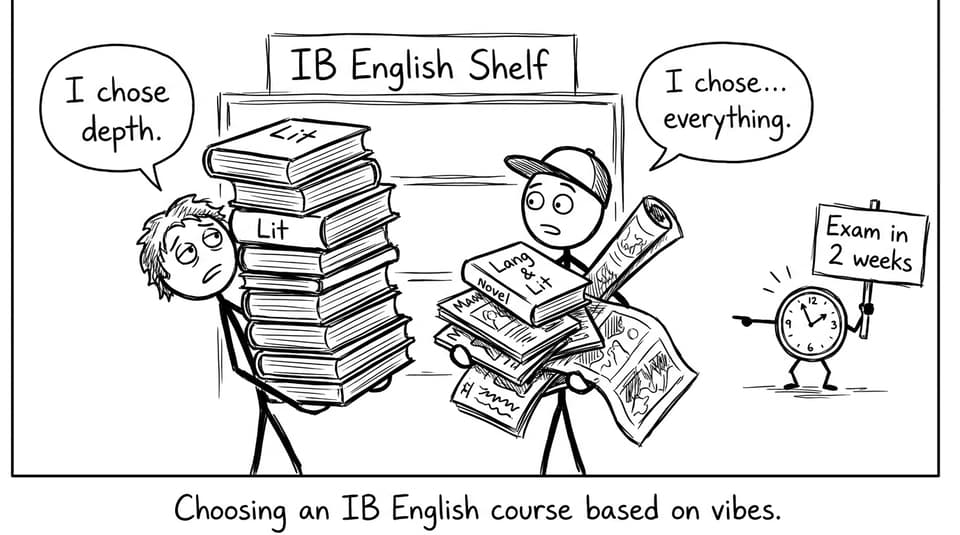
Use this as a fast filter before we go deeper. In IB English, the “right” course is usually the one that rewards your natural curiosity.
-
Do you want to study only literary works (novels, plays, poetry)? That points toward IB English Literature.
-
Do you want a mix of literary and non-literary texts (ads, speeches, journalism, visual texts, social media style writing)? That points toward IB English Language and Literature.
-
Do you enjoy close reading more than context debates?
-
Or do you like asking, “Who made this, for whom, and why now?”
-
Are you SL or HL? (HL adds the HL Essay, which changes your workload in both courses.)
For a bigger map of the whole subject, keep this open: What Is the IB English Curriculum? A Complete Breakdown.
IB English Literature syllabus: what you actually study
IB English Literature is the course for students who want depth. It’s built around literary works across time periods, genres, and cultures, with heavy emphasis on interpretation: how writers shape meaning through choices.
Core focus in IB English Literature
-
Literary works only: prose, poetry, drama
-
Attention to form, structure, style, and literary technique
-
A strong habit of close reading (what the words do, line by line)
-
Cultural and contextual awareness (especially through translated works)
A useful home base if you’re in this course: IB English A Lit Resources.
Typical components you’ll recognize
Depending on your school’s selections, the Literature course tends to include:
-
Works in translation (texts originally written in another language)
-
Detailed study of chosen works
-
Range across genres (poetry, drama, prose)
-
Practice in textual analysis and comparative thinking
IB English Language and Literature syllabus: what you actually study
IB English Language and Literature (often “Lang Lit”) is the course for students who want range. You still study literary works, but you also analyze the kinds of texts that shape public opinion every day.
Core focus in IB English Language and Literature
-
Literary + non-literary texts
-
How language works in different contexts, media, and audiences
-
Skills in rhetoric, bias, purpose, and representation
-
Strong emphasis on how meaning changes with format and platform
If you want a syllabus-aligned hub for revision: IB English A Lang & Lit Resources and the IB English A Lang & Lit Revision Notes.
Assessment comparison: what changes (and what stays the same) in IB English
Here’s the reassuring part: across IB English, both courses train the same core muscle: turning observations into a clear argument supported by evidence.
Here’s the practical part: the kind of evidence and the kind of observation shifts.
Paper 1 in IB English: the “unseen” test
-
In IB English Literature, Paper 1 is an analysis of unseen literary text(s).
-
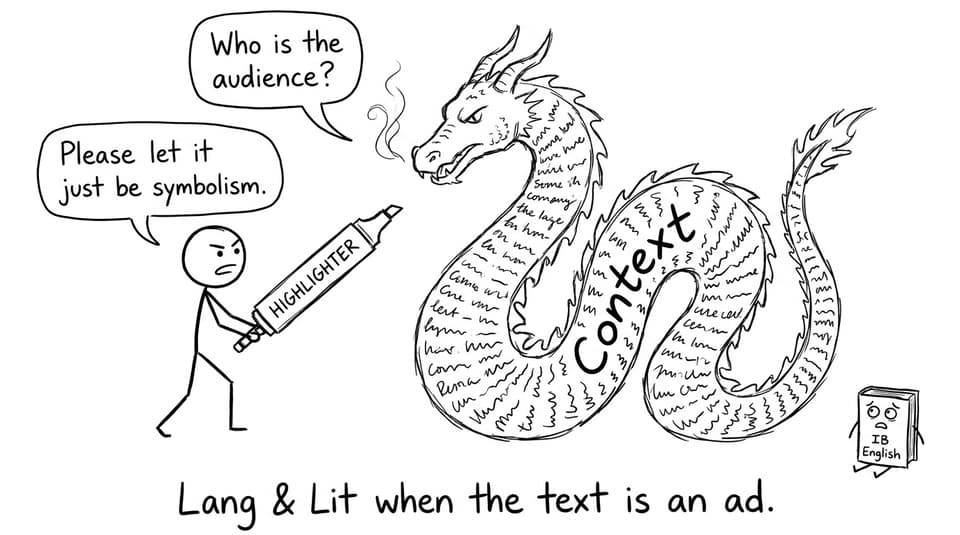
In IB English Language and Literature, Paper 1 is typically analysis of unseen non-literary text(s) (and in many contexts, a broader range of text types).
In both, your marks come from how well you analyze choices (diction, imagery, tone, structure, visuals) and build a controlled commentary.
For HL essay-writing skills that also strengthen Paper 1, this is helpful: IB English HL Essay Prep: 10 Steps to Confidence.
Paper 2 in IB English: the comparison game
Paper 2 is where both courses overlap more than students expect.
-
You write a comparative essay on two works you studied.
-
The prompts are broad, which means your planning and recall matter.
If Paper 2 feels foggy, use this breakdown: IB English Paper 2 Structure: Lang & Lit Guide and this comparison tool: Thematic Comparisons Across IB Prescribed Texts.
The Individual Oral (IO): the skill that reveals your course
The IO is where course identity becomes obvious.
-
In IB English Literature, your oral is anchored in literary works and how authorial choices shape meaning.
-
In IB English Language and Literature, the oral commonly pairs a literary work with a non-literary body of work, often through the lens of a global issue.
If you tend to think in themes, symbols, and narrative voice, Lit can feel intuitive. If you naturally ask “who benefits from this message?” Lang Lit can feel like home.
HL Essay (HL only): same task, different comfort zones
At HL, both courses add the HL Essay (1,200-1,500 words). It rewards depth, not plot summary.
Two links worth keeping open:
And if you want examples plus a way to self-check with criteria language: IB Language A: HL Essay Examples.
The real difference: what each IB English course trains you to notice
IB English Literature trains depth
Lit students get very good at staying still with a passage. Noticing pattern. Returning to a single metaphor and watching it evolve. Hearing the narrator’s silence as part of the meaning.
That depth is powerful in Paper 1 and Paper 2, especially when you can link method (choices) to message (meaning).
IB English Language and Literature trains range
Lang Lit students get good at switching modes without losing clarity: from a political speech to an infographic, from an editorial to a poem.
It’s not “less literary.” It’s a wider definition of text, and a sharper attention to audience, purpose, and context.
If you’re still weighing difficulty, this helps: Is IB English Literature More Difficult Than IB English Language and Literature?.
How to revise for IB English based on your course
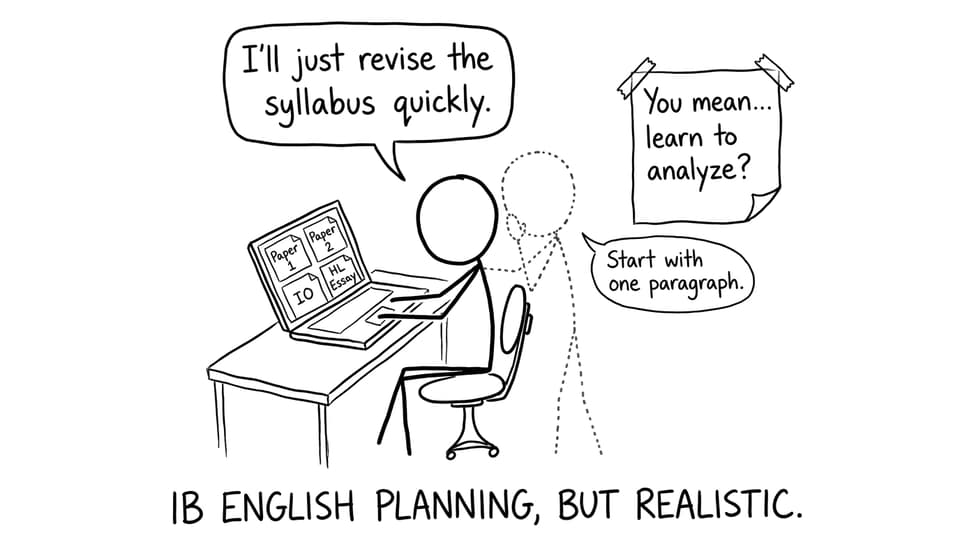
A calm revision rule: don’t revise “English.” Revise the assessment behaviors.
-
Build a Paper 1 routine: annotate fast, pick 3-4 techniques, write in a tight structure.
-
Build Paper 2 memory: 6-8 flexible quote moments per work, organized by theme and method.
-
Build IO preparation: 2-3 global issues you can adapt, with clean evidence.
-
If HL: build an HL Essay pipeline (LOI, passage bank, paragraph plans).
RevisionDojo is built to support that kind of targeted practice: Study Notes for technique, Flashcards for quote recall, AI Chat to test interpretations, Grading tools to see what the rubric rewards, and Mock Exams and Predicted Papers to train timing. When you need extra structure, Questionbank practice and Tutors can turn vague effort into specific improvement.
FAQ: IB English Literature vs IB English Language and Literature
Which IB English course is better for higher grades?
Grades in IB English usually come down to fit, not prestige. If you naturally enjoy close reading and you’re willing to re-read, annotate, and write about technique, Literature can feel more straightforward because your focus stays consistent. If you enjoy analyzing rhetoric, bias, visuals, and real-world context, Language and Literature often feels more intuitive because it matches how you already read the world. Both courses reward the same fundamentals: clear thesis, accurate understanding, method-based analysis, and organized writing. The “easier” course is usually the one that doesn’t punish your weakest habits every week. If you’re unsure, compare how you feel doing Paper 1 style tasks in each course.
Do both IB English courses have the same exams?
Both IB English courses share a similar skeleton, but the muscles are different. Paper 2 is broadly comparable because it’s a comparative essay on works you studied, and the marking logic is similar: argument, evidence, technique, and structure. Paper 1 differs more because Literature focuses on unseen literary text analysis, while Language and Literature typically uses a wider range of unseen non-literary texts. The Individual Oral also differs in how it uses texts and global issues, especially in Lang Lit where a non-literary body of work is commonly involved. At HL, both courses include the HL Essay, which adds a long-form analytical task that rewards planning over last-minute inspiration. The best exam prep is always course-specific, even when the paper names look the same.
If I’m taking SL, does the choice between IB English courses matter less?
It matters, just in a quieter way. At SL, you won’t write the HL Essay, so your workload shifts more heavily toward Paper 1, Paper 2, and the IO. That makes course fit even more important because your assessment profile is concentrated: you’re repeatedly asked to do the “signature moves” of your course under time pressure. In IB English Literature, that means literary close reading and literary comparison; in Lang Lit, it means flexible analysis across media and context. SL students often underestimate how much consistency helps: if you like the text types you study, you practice more willingly, and your writing improves faster. Even at SL, choosing the right course can make revision calmer and more effective.
Choosing your IB English course (and revising like it counts)
If IB English Literature feels like a long conversation with books, and you want to listen closely, choose it.
If IB English Language and Literature feels like learning to read the world with sharper eyes, choose that.
And once you’ve chosen, revise like an examiner is your audience: practice the paper you’ll sit, write the paragraphs you’ll be marked on, and build evidence you can actually recall.
When you’re ready to make that practical, RevisionDojo gives you a single place to train the real skills: Questionbank drills, Study Notes, Flashcards, AI Chat, Grading tools, Mock Exams, Predicted Papers, a Coursework Library, and support from Tutors when you want feedback that actually moves your score.