
If you’ve ever stared at a university application checklist and felt your stomach drop at the word “IELTS,” you’re not alone. The test isn’t just a few extra boxes to tick. It’s time, money, scheduling, and another performance day when you already have enough.
Here’s the calmer truth: IB English can sometimes replace IELTS as proof of proficiency. Not always. Not automatically. But often enough that it’s worth understanding early, while you still have room to plan.
The quick checklist for IB English and IELTS exemption
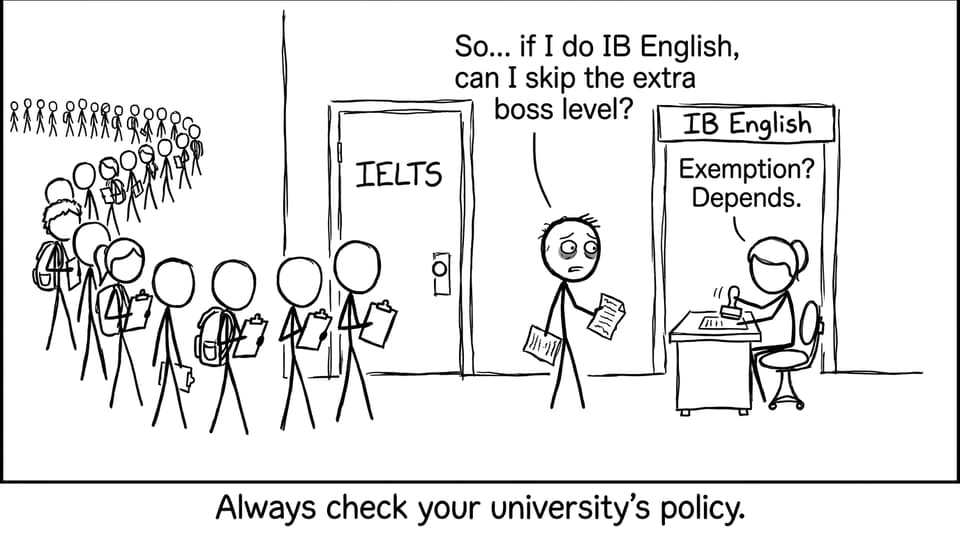
Use this list before you assume you’re “covered” by IB English.
-
Confirm whether your target university accepts IB English as English proficiency proof.
-
Check which course they accept (English A vs English B is a common dividing line).
-
Check level requirements (SL vs HL).
-
Check minimum grade requirements (often 5+, sometimes higher).
-
Separate university admissions rules from visa rules (especially for the UK).
-
Save a screenshot or PDF of the policy page for your records.
If you want a fast starting point, RevisionDojo’s breakdown of Which IB English Class Exempts You from IELTS? maps the most common policy patterns.
What IB English actually is (and why it matters to universities)
IB English in the Diploma Programme isn’t designed as a language proficiency test. It’s designed as an academic subject that trains you to read like a critic, write like a thinker, and speak like someone who can hold a complex argument without hiding behind memorized phrases.
That’s exactly why universities often respect it.
Most policies that grant an IELTS exemption are referring to IB English A courses:
-
English A: Literature
-
English A: Language and Literature
These courses are widely treated as “Language A” pathways. In plain terms, universities see them as evidence you can handle English at a near-native academic level, because your grades come from sustained performance across exams and internal assessment.
For course-specific guidance and exam structures, the IB English A: Language & Literature resources page is a helpful overview hub.
A 60-second IELTS refresher (so you know what you’re being compared to)
IELTS is a standardized English proficiency exam used for admissions, immigration, and professional registration. It tests four skills: listening, reading, writing, speaking.
A key difference: IELTS is a snapshot. One sitting, one score.
IB English is a long exposure photograph. Your final grade reflects months of reading, writing, speaking, planning, revising, and performing under different conditions.
So when universities accept IB English in place of IELTS, they’re saying: “This student’s academic English has already been proven in a way we trust.”
How IB English connects to IELTS exemption (the three reasons)
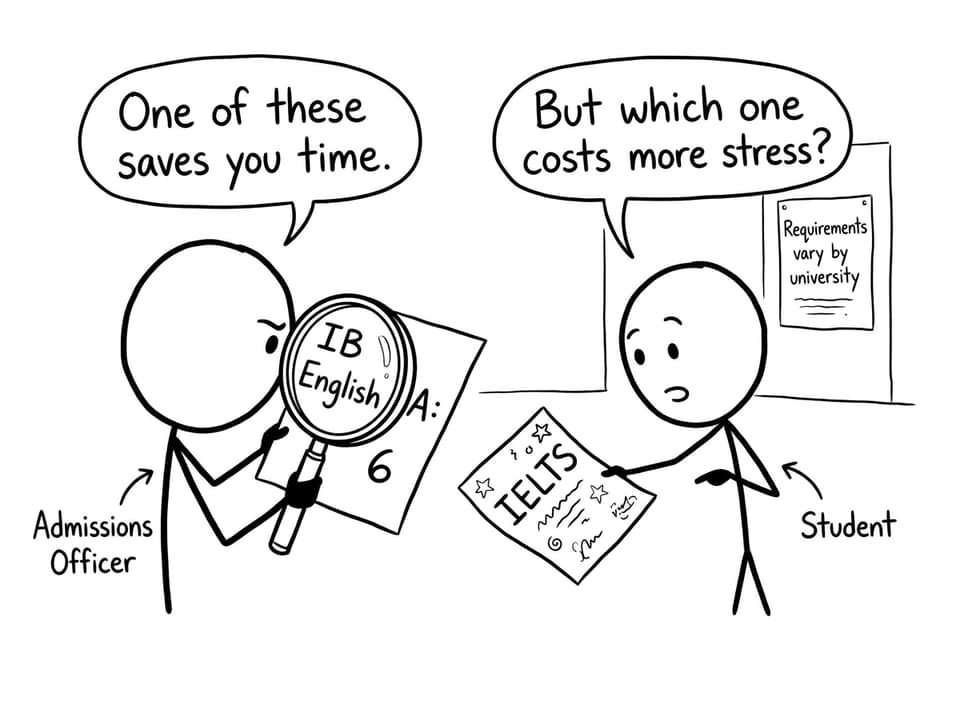
Universities don’t offer an IELTS exemption out of kindness. They do it because IB English signals three things that matter on day one of lectures.
Demonstrated proficiency over time
With IB English, you’re assessed through multiple tasks: timed analysis, comparative essays, and speaking. That breadth makes your grade a strong proxy for the day-to-day English you’ll need in seminars and written assignments.
Skills alignment with academic success
Even if the formats differ, IB English trains the same foundations IELTS tries to measure: comprehension, clarity, structure, vocabulary control, and the ability to respond to unseen material.
If you’re actively training these, use targeted practice systems like IB English Study Techniques That Actually Work. It’s the difference between “I read the book” and “I can produce analysis on demand.”
Global recognition (with local rules)
The IB’s reputation helps, but your university’s policy still wins. Two universities can sit in the same city and treat IB English differently depending on department, course competitiveness, or national regulations.
What grade in IB English typically exempts IELTS?
There isn’t one universal threshold. But many universities set a minimum around 5 in IB English A (and sometimes they ask for 6 or 7 for more competitive programs).
RevisionDojo summarizes common grade expectations in What IB English Grade Exempts You from IELTS?. Use it as a benchmark, then confirm with your actual university.
The UK complication: university rules vs visa rules
If you’re applying to the UK, treat this as two separate questions:
-
Does the university accept IB English as meeting their English language requirement?
-
Does your visa pathway require anything additional?
Many students only ask question one, celebrate early, and then scramble late.
Start here: IB English for a UK Student Visa: Is It Enough?. It explains why “admissions requirement met” and “visa requirement met” can look similar but behave differently.
What about IB English B?
Students ask this because it feels unfair: you are studying in English, writing in English, presenting in English, and still being told you might need IELTS.
The reason is structural. IB English B is a language acquisition course, not a “Language A” course. Many universities still accept it, but policies can be stricter and more variable.
If that’s your situation, compare:
Even if you’re taking English B, strong planning matters. You want margin, not a just-barely score that leaves you vulnerable to policy changes.
How to strengthen your IB English results (and reduce the need for backups)
The best way to “earn” an IELTS exemption through IB English is simple: make your grade predictable.
Build exam-ready analysis (not just good ideas)
In IB English, you don’t get marks for having a thought. You get marks for shaping it into an argument the examiner can reward.
Use the criteria as your training plan. RevisionDojo’s guide to IB English assessment criteria for oral and written exams helps you translate effort into marks.
Train your Individual Oral like it’s a performance skill
The IO rewards structure, relevance to the global issue, and confident control of evidence. It’s not a memorization contest.
For rehearsal systems, start with IB English Individual Oral: Strategies + Practice Tools. Pair it with RevisionDojo’s AI Chat to test your global issue framing and your line of argument under pressure.
Use RevisionDojo like a training gym
A useful way to think about IB English prep is that you’re building repeatable reps:
-
Study Notes to clarify concepts fast
-
Flashcards for technique language and thesis stems
-
Questionbank drills for Paper 1 and Paper 2 planning habits
-
Grading tools to self-check against the rubric
-
Mock Exams to normalize timing and reduce panic
-
Predicted Papers to practise adaptability (without guessing your future)
-
Coursework Library for examples and structure patterns
-
Tutors when you need targeted feedback instead of generic advice
FAQ
Can IB English automatically exempt me from IELTS everywhere?
No, IB English does not automatically exempt you from IELTS everywhere, even if you are taking English A and scoring well. Universities set their own English language policies, and those policies can vary by country, institution, and even department. Some programs (like medicine, law, or education) may have stricter language requirements than the rest of the university. Another common twist is timing: a university might accept predicted grades for a conditional offer, but still require final results before you enroll. The safest approach is to treat IB English as a strong credential, then confirm the exact rule in writing for your course. Keep a screenshot or saved PDF so you can reference the requirement if something changes later.
Which IB English courses are most likely to qualify for an IELTS exemption?
In many admissions policies, IB English A courses are the most consistently accepted for IELTS exemption. That typically includes English A: Literature and English A: Language and Literature at either SL or HL, depending on the university. These are “Language A” courses, which universities interpret as evidence of advanced academic reading and writing. IB English B may still be accepted at some universities, but it is more variable because it’s a language acquisition course. Some universities also specify minimum grades differently depending on SL vs HL, which can surprise students who assume level does not matter. If you want to avoid last-minute stress, confirm the exact course name and level stated in your university’s policy.
What should I do now if I’m relying on IB English for IELTS exemption?
First, search your university’s official English language requirements page and look for IB English by name, not by assumption. Second, identify the minimum grade required and decide whether you need a “buffer” (for example, aiming for a 6 when the minimum is 5). Third, build your revision around what is assessed: Paper 1 analysis routines, Paper 2 comparison structures, and IO rehearsal with feedback. Fourth, create a backup plan early in case your target program changes its rule or asks for extra proof, especially for visa-related cases. Finally, make your improvement measurable: use RevisionDojo’s Questionbank, Study Notes, Flashcards, AI Chat, and Mock Exams to turn practice into patterns you can repeat under timed conditions. When IB English becomes predictable, the admissions process feels less like luck and more like logistics.
Closing thoughts: treat IB English as proof, not a gamble
The point of IB English isn’t to dodge a test. It’s to become the kind of reader and writer who doesn’t need shortcuts. The IELTS exemption is just a side effect that sometimes arrives when your work is strong and your university’s policy aligns.
If you want that alignment to work in your favor, make your next step practical: build a grade margin, confirm requirements early, and train each assessment with intention. RevisionDojo can help you do that with its Questionbank, Study Notes, Flashcards, AI Chat, Grading tools, Predicted Papers, Mock Exams, Coursework Library, and Tutors, so IB English becomes your advantage, not your uncertainty.