



If you have ever stared at your Internal Assessment draft and felt a quiet dread creeping in, you are not alone. The IA is strange because it is personal: your topic, your choices, your writing voice. And yet it gets judged with something that feels cold and mechanical: the Rubric & Mark Scheme.
That contrast is where most IA anxiety lives. Not in the writing itself, but in the question: How does this turn into marks, and how do marks turn into a grade? Once you understand the code, the fear gets smaller. The work gets clearer.
The goal of this guide is simple: help you interpret IA grade boundaries through the lens that actually matters, which is the Rubric & Mark Scheme, so you can focus on the highest-return improvements before exams.
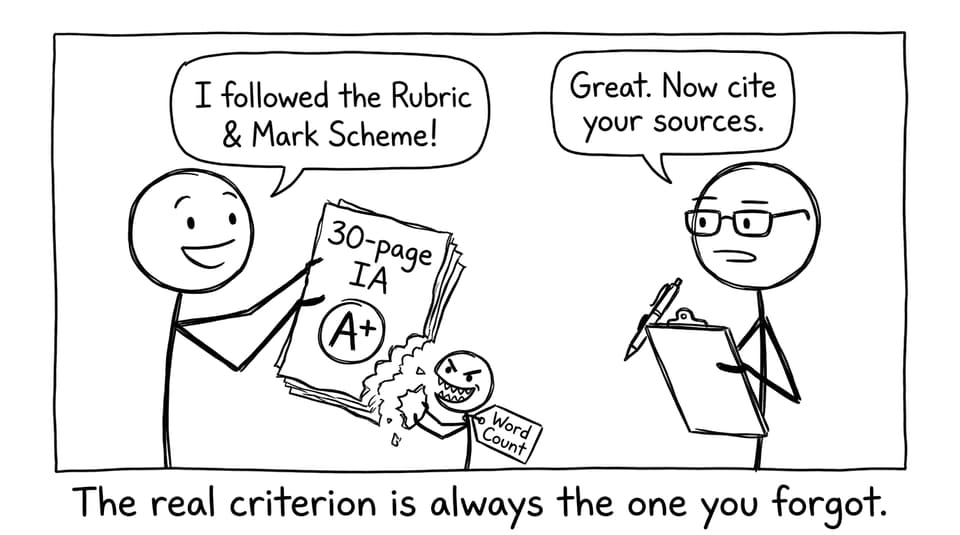
The quick checklist: decode your IA in 15 minutes
Before you chase a boundary number, do this rapid audit using the Rubric & Mark Scheme:
-
Identify your criteria and their max marks (example: 24, 20, 25).
-
Highlight phrases that appear in the top band (usually the difference-makers).
-
For each criterion, write one sentence: “My evidence for this is…”
-
Circle any criterion where your sentence feels vague.
-
Fix the vaguest criterion first, since it is usually your easiest mark gain.
If you want tools that keep this process structured, RevisionDojo’s IA-focused resources are a strong starting point: IB Internal Assessment Guides.
What grade boundaries really mean (and why they keep shifting)
Students often treat grade boundaries like a locked door: If I hit 18/24, I get a 7. If I hit 17/24, I do not. Real life is softer.
Grade boundaries are better understood as a conversion table used after marking. They vary by subject and session because cohorts vary. That is why chasing a single “magic number” can create false certainty.
Here is the calmer truth: your best predictor of outcome is not the boundary itself, but how tightly your work matches the Rubric & Mark Scheme language.
That is also why moderation matters. Your teacher’s mark is usually a strong estimate, but not always the final number after IB standardization. If you want this explained clearly, read: Do Teachers Know Your Final IA Mark? (IB Explained).
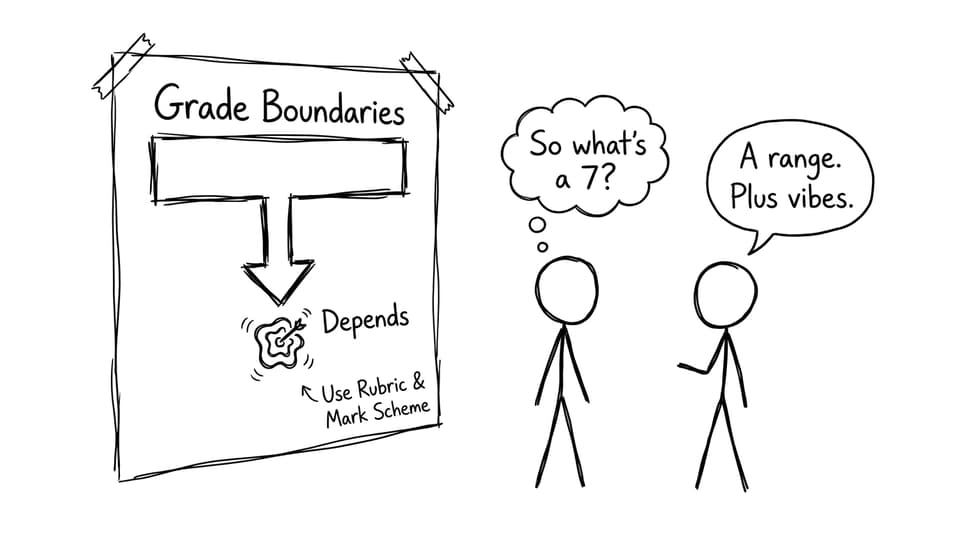
Typical IA mark-to-grade patterns (by common components)
Different subjects use different totals, but many IAs cluster around a familiar structure: a fixed number of criteria, each with band descriptors, summed to a total mark. Below are common patterns that help you orient yourself.
Sciences: often out of 24
In many science-style investigations, the total is commonly 24 marks. A typical boundary pattern students use for orientation looks like this:
-
7: ~20/24
-
6: ~17-19/24
-
5: ~14-16/24
-
4: ~11-13/24
-
3: ~7-10/24
-
2: ~4-6/24
-
1: ~0-3/24
The important part is not the exact cutoffs. It is the fact that one messy criterion can cost you multiple marks fast. The Rubric & Mark Scheme rewards precision.
Mathematics: often out of 20
Math exploration marking often feels strict because clarity is part of the assessment. A common orientation pattern is:
-
7: ~18/20
-
6: ~15-17/20
-
5: ~12-14/20
-
4: ~9-11/20
-
3: ~6-8/20
-
2: ~3-5/20
-
1: ~0-2/20
In other words: you cannot “vibe” your way to the top band. Your communication and mathematical reasoning must map to the Rubric & Mark Scheme descriptors.
History: often out of 25
History investigations are usually marked out of 25, often with multiple criteria that reward source handling and analysis. A common orientation pattern looks like:
-
7: ~20/25
-
6: ~16-19/25
-
5: ~13-15/25
-
4: ~9-12/25
-
3: ~6-8/25
-
2: ~3-5/25
-
1: ~0-2/25
If you want an extremely practical way to interpret the Rubric & Mark Scheme for History, RevisionDojo has a dedicated tool: IB History IA Grader.
The “IA code” is just the Rubric & Mark Scheme plus evidence
A useful mental model: marks are not a judgment of how hard you worked. They are a judgment of how visible your thinking is.
Examiners cannot reward intentions. They reward evidence. The Rubric & Mark Scheme is basically a checklist of what “visible thinking” looks like.
What top-band work usually does differently
It writes for a tired examiner
Short signposts. Clear labeling. Direct answers.
It makes claims and immediately proves them
Not “this shows a trend.” Instead: “This shows a trend because… (data) … therefore…”
It respects the criterion language
If the descriptor says “justified,” you justify. If it says “evaluated,” you evaluate. If it says “focused,” you delete the distracting section.
This is also why practicing with real marking logic matters for exams too. RevisionDojo’s Questionbank trains you to think in mark points and command terms, which quietly carries over into coursework writing.
How RevisionDojo helps you raise your IA mark without guessing
The most stressful part of the IA is not writing it. It is not knowing which edits matter.
RevisionDojo is built for that moment when you want clarity, not comfort:
-
Grading tools that mirror how the Rubric & Mark Scheme is applied. For example, the IB Business Management IA Grader breaks criteria into plain English and shows what to fix.
-
AI Chat for fast unblocking when you cannot tell whether your evaluation is strong enough.
-
Study Notes to tighten subject knowledge behind your analysis, not just your formatting.
-
Flashcards to keep key definitions and criterion language retrievable under pressure. If you are building a daily recall habit, this helps: IB Flashcard System: Active Recall for Better Memory.
-
Coursework Library for exemplars and structure guidance when you need a model.
-
Tutors when you want real-time feedback loops.
-
Mock Exams and Predicted Papers to keep exam prep moving so your IA does not consume everything.
If you are also struggling with that “I studied all day and nothing stuck” feeling, you will relate to: IB: I Study All Day but Remember Nothing.
Closing: boundaries are the headline, Rubric & Mark Scheme is the story
It is easy to obsess over IA grade boundaries because they feel like a verdict. But boundaries are just a conversion table at the end of a long process. The real lever you control is the Rubric & Mark Scheme: the language, the evidence, the clarity.
If you want to stop guessing and start improving with intent, build your workflow around RevisionDojo: use Study Notes to sharpen understanding, Questionbank to train mark-aware thinking, Flashcards to keep key ideas retrievable, AI Chat to unblock confusion, and Grading tools to align your draft to the Rubric & Mark Scheme before submission. Your IA does not need to feel like a mystery. It can feel like a checklist you know how to finish.