
In IB Visual Arts, the exhibition can feel like a quiet, slow-moving storm. It starts as a few sketches in the margins of your notebook, then turns into something bigger: deadlines, material experiments, half-finished pieces leaning against your wall, and that one work you loved until you looked at it again at 1:12 a.m.
The strange thing is that the exhibition isn’t asking you to be a “genius.” It’s asking you to be intentional. To make choices you can defend. To show growth you can prove. And to turn your studio mess into a clear story an examiner can follow.
This short guide walks you through how to smartly plan and execute your IB Visual Arts exhibition so it’s cohesive, manageable, and genuinely yours.
IB Visual Arts exhibition quick checklist
If you want the simplest way to stay calm, use this checklist weekly. A strong IB Visual Arts exhibition usually has:
-
A theme or guiding question you can explain in one sentence
-
A realistic production plan (time, materials, sizes)
-
Evidence of trial-and-error you document (even the failures)
-
A selection of resolved works that feel connected (not random)
-
Exhibition text that clarifies intention and choices
-
A curatorial rationale that explains the exhibition as a body of work
When you’re unsure what examiners value most, keep these open while you curate: How Examiners Grade the IB Visual Arts Exhibition and IB Visual Arts Assessment Criteria Explained Simply.
Understand what the exhibition is really measuring in IB Visual Arts
People outside the course sometimes assume art is “less academic.” But IB Visual Arts is assessed with criteria just like your other subjects. The difference is that your evidence isn’t an exam script. It’s your decision-making, documented over time.
Your exhibition is evaluated alongside two other components:
-
Comparative Study (external)
-
Process Portfolio (internal, moderated)
-
Exhibition (internal, moderated)
If you need a clear overview of how the course fits together, read What is IB Visual Arts?. And if you’re still deciding between levels, SL vs HL in IB Visual Arts: What’s the Difference? helps you plan workload early.
Pick a theme that is specific, personal, and buildable
The best exhibition themes are rarely the loudest. They’re the ones you can live with for months.
Many students start with broad topics (love, pain, identity, heartbreak). Those can work, but they often become vague because they’re too big to control. The smarter move in IB Visual Arts is to narrow the theme until it creates decisions.
A useful test: can your theme make you say “therefore”?
Instead of:
- “Pain”
Try:
- “The pain of outgrowing a childhood version of yourself”
Now you can say: I’m exploring the pain of outgrowing a childhood self, therefore I’ll use fragile materials, awkward scale shifts, and unfinished edges. That “therefore” is curatorial power.
Build your theme from a repeatable observation
Look for something you keep noticing:
-
The same kind of silence at home
-
The way people curate themselves online
-
A ritual you’ve done for years
-
A specific fear, habit, or memory you return to
If you want more theme and portfolio guidance, Creating an Outstanding IB Visual Arts Portfolio shows how to keep the exhibition and process portfolio aligned.
Plan the exhibition like a small system, not a last-minute sprint
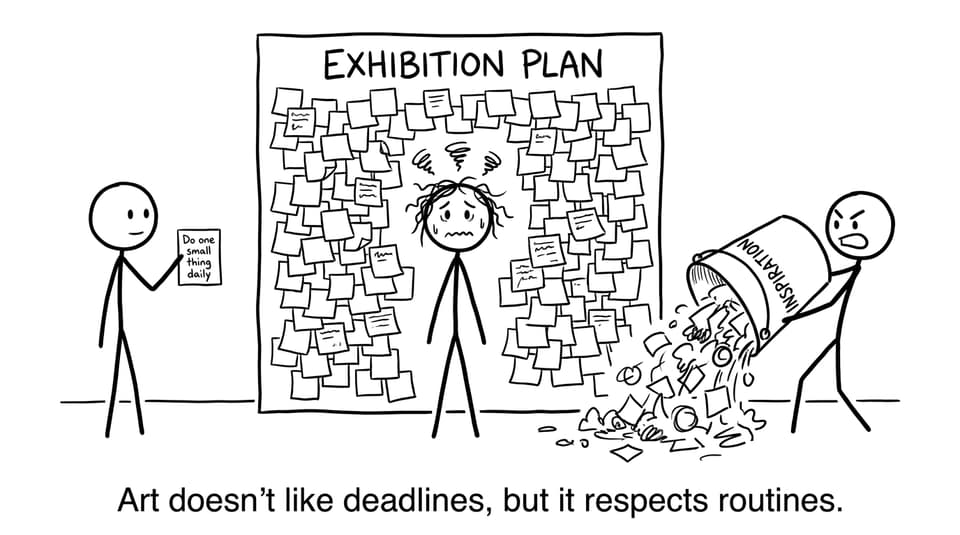
A common trap in IB Visual Arts is treating production like a single heroic push. But art doesn’t reward panic. It rewards repetition.
Here’s a smarter planning rhythm:
Create a simple “piece pipeline”
For each artwork, track four stages:
-
Idea sketch + 1 sentence intention
-
Material tests (small, cheap, fast)
-
First draft (ugly version allowed)
-
Refinement + decision log
That decision log becomes fuel for your Process Portfolio and makes your exhibition text easier to write.
For broader routines and study habits that actually fit the subject, How to "Study" IB Visual Arts Effectively is worth bookmarking.
Draft widely, then choose deliberately
Early drafting is not about being brilliant. It’s about giving your future self options.
When inspiration hits, capture it in the smallest possible form:
-
A thumbnail sketch
-
A photo
-
A palette test
-
A paragraph of messy writing
Later, you curate your own ideas. In IB Visual Arts, that curation is part of what examiners value: you’re showing judgement, not just output.
Use a “triangle rule” to avoid repetitive pieces
When choosing which ideas become final works, try to make each piece different in at least one of these ways:
-
Medium (painting, sculpture, photography, digital, print)
-
Scale (intimate vs immersive)
-
Point of view (literal vs symbolic, personal vs observational)
Variety matters, but purposeful variety matters more. This is exactly what’s discussed in IB Visual Arts Assessment Criteria Explained Simply.
Choose materials that argue for your idea
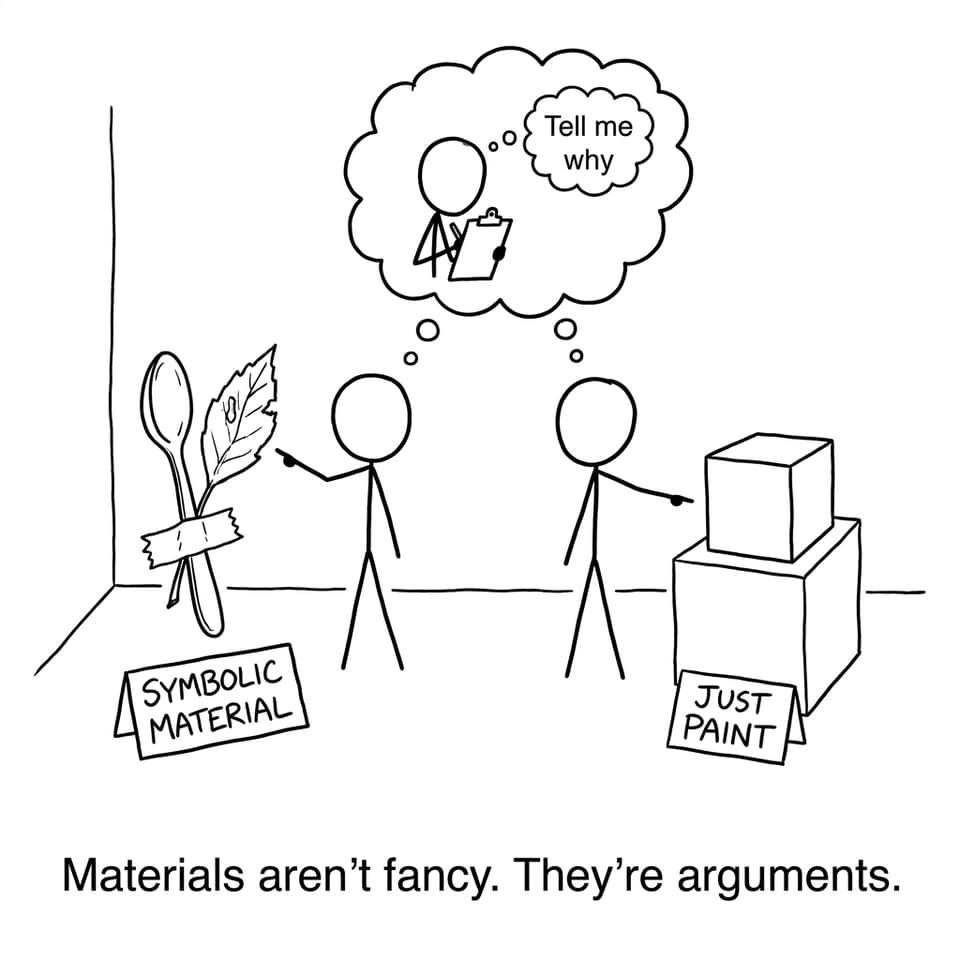
Materials aren’t decoration. They are meaning.
If your theme is about fragility, glass-like surfaces, thin paper, cracking texture, or brittle joins can communicate that before anyone reads your text. If your theme is about resistance, dense layering, heavy supports, stitched repairs, or abrasive texture can do the same.
The key in IB Visual Arts is not “fancy materials.” It’s justified materials.
Ask yourself:
-
What does this material do physically (reflect, tear, stain, blur)?
-
How does that physical behavior match the idea?
-
What did I test, and what did I change?
Treat failure as part of the exhibition plan (and document it)
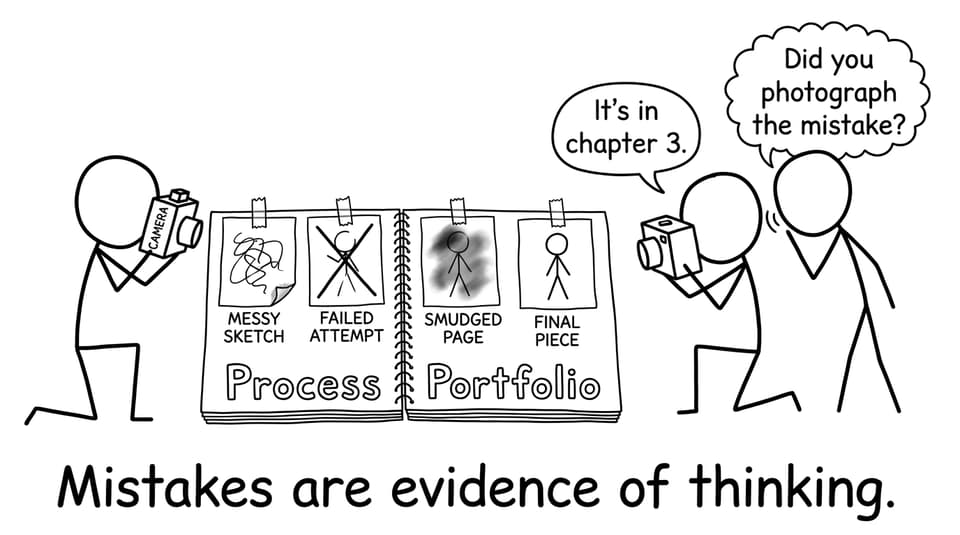
Every strong IB Visual Arts exhibition contains hidden failures. The difference is that top students don’t hide them from their documentation. They mine them.
A collapsed sculpture can become:
-
a redesign with stronger joints
-
a conceptual shift toward instability
-
a process portfolio page about structure, balance, and learning
Document:
-
what you intended
-
what happened
-
why it happened (materials, timing, technique)
-
what you changed next
If you want concrete ways to show experimentation, How to Show Experimentation in Your IB Visual Arts Process Portfolio gives practical formats that examiners understand quickly.
Write exhibition text and curatorial rationale that sounds like you (but clearer)
Exhibition writing often fails for one reason: it describes the artwork, but doesn’t justify the choices.
Aim for three layers:
Artwork intention
What question or idea is this piece exploring?
Artistic decisions
Why these materials, scale, composition, or process?
Viewer experience
What do you want the viewer to notice, feel, or question?
In IB Visual Arts, the examiner is looking for coherence between what you say and what you made. If you want a plain-language breakdown of what earns marks, revisit How Examiners Grade the IB Visual Arts Exhibition.
Curate the final presentation like punctuation
Think of your exhibition as a story told through objects. The order, spacing, and labels are the punctuation.
Small curatorial choices that lift a IB Visual Arts exhibition:
-
Keep labels consistent (font, size, placement)
-
Control sightlines (what the viewer sees first)
-
Group works that “speak” to each other
-
Use lighting intentionally (avoid accidental glare)
-
Photograph the final setup professionally for records
If you’re worried you’re repeating common mistakes, Most Common Mistakes in IB Visual Arts: Pitfalls to Avoid is a fast way to spot problems before they cost you time.
How RevisionDojo helps you execute IB Visual Arts with less stress
The hardest part of IB Visual Arts isn’t the moment you present your work. It’s the months of decisions leading up to it.
RevisionDojo is built for that messy middle:
-
Use the Coursework Library to study strong samples: IB Visual Arts Examples
-
Check your documentation against criteria with the Grading tools: IB Visual Arts Process Portfolio Grader
-
Use Study Notes and Flashcards to lock in art vocabulary and analysis habits
-
Use AI Chat to refine curatorial rationale wording and tighten reflection (without losing your voice)
-
Build confidence with Mock Exams and Predicted Papers in your other IB subjects so art deadlines don’t sink your whole schedule
-
Drill weak areas with the Questionbank when your brain needs something structured after studio work
-
If you’re stuck, RevisionDojo Tutors can give targeted feedback on theme clarity, selection, and writing
Closing: a calm way to finish your IB Visual Arts exhibition
The exhibition feels enormous when you imagine it all at once. But in practice, a strong IB Visual Arts exhibition is built the same way a sketch becomes a drawing: one small decision, then another, then a revision that makes the whole thing clearer.
Pick a theme you can stand behind. Work in a steady rhythm. Let experiments be messy. Document what changed. Curate the final selection like it’s a sentence you want someone else to understand.
When you want structure in the middle of the chaos, use RevisionDojo to keep your IB Visual Arts work aligned with criteria through the Coursework Library, Grading tools, AI Chat, Study Notes, and support from Tutors. Your art can stay human. Your plan can stay smart.