
TOK is the only place in the IB where you can lose sleep over a single word that changes nothing, and still be completely rational.
One student writes 1,842 words because they are “on a roll.” Another submits 1,097 because they “said everything important.” Both are reacting to the same pressure: the TOK essay feels philosophical, but it is assessed like a disciplined academic argument. Word count is where that discipline becomes visible.
So, how long should a TOK essay be? Long enough to show real evaluation, but controlled enough to prove you can prioritise. In other words: you are not just writing more. You are choosing better.
TOK essay word limit: the official rule (and the real sweet spot)
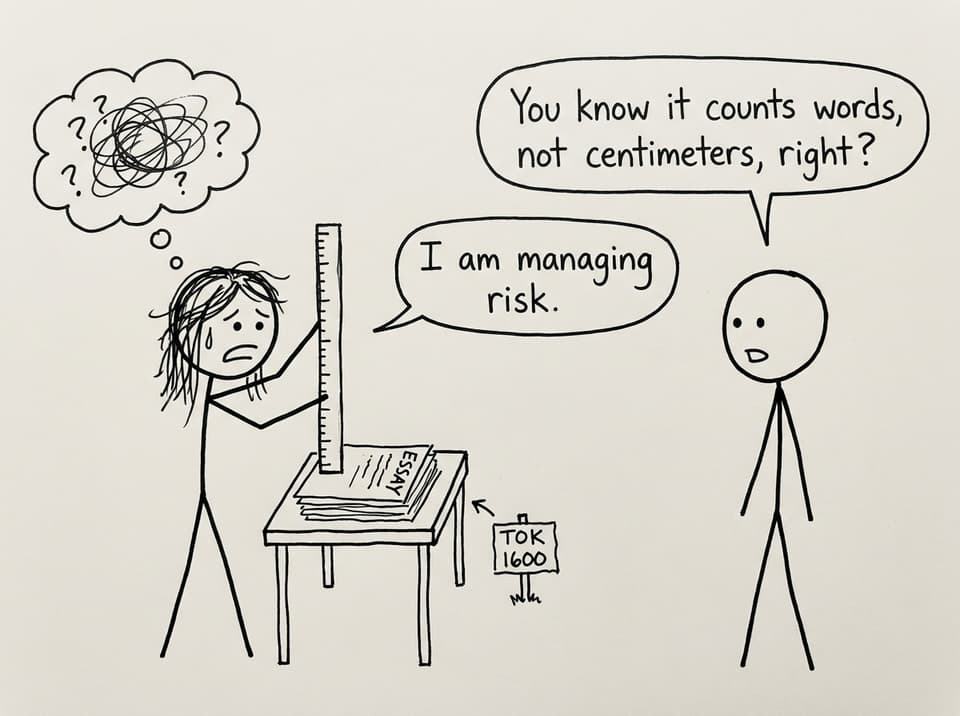
The official IB maximum for the TOK essay is 1,600 words. This is the hard ceiling, and it is not negotiable.
In practice, most strong TOK drafts land in a “sweet spot” around 1,300 to 1,500 words. That range gives you room to define key terms, explore claims and counterclaims, and evaluate real-life examples without padding.
If you want a quick overview of what the assignment expects beyond length, keep IB TOK requirements explained open while you draft. TOK is easier when you can see the whole playing field.
What happens if you go over 1,600 words in TOK?
Going over the TOK limit is a classic trap because it feels like you are being “thorough.” But in TOK, thoroughness is not the same as precision.
When you exceed 1,600 words, you risk being penalised. More importantly, you risk signalling something examiners notice immediately: you could not control your argument. TOK rewards focus and evaluation, not extra explanation.
What counts in the TOK word count (and what doesn’t)
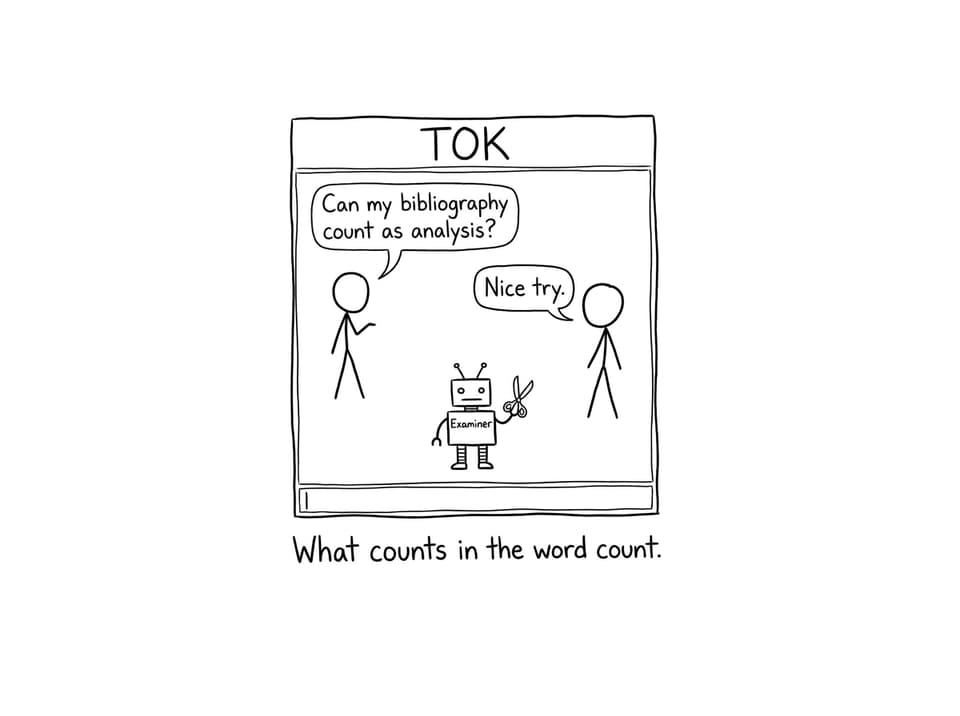
A huge part of managing TOK length is knowing what the word count includes. Students often cut the wrong sections, or worse, hide analysis where it doesn’t belong.
Included in the TOK word count
These are counted:
-
Your full essay body (obviously)
-
Quotes you include in the main text
-
Your analysis and evaluation of examples
-
Any substantive content you add in the main writing
If you are unsure how your paragraphs should carry the argument, pair this post with How many paragraphs should a TOK essay have?. It is one of the easiest ways to prevent your TOK draft from becoming “long but thin.”
Not included in the TOK word count (with a warning)
Typically not counted:
-
Title page
-
Bibliography / references
-
Footnotes only when used for citation
The warning matters. If your footnotes become a second essay, extra evaluation, extra examples, extra argument, you are basically betting your grade that nobody notices. In TOK, that is rarely a good bet.
A practical TOK word count checklist (use this before you submit)
TOK is a thinking task, but meeting the word limit is a process task. Use this checklist the night before you upload the final PDF.
-
Are you under 1,600 words?
-
Is your introduction about 150-200 words, not a mini textbook?
-
Do you have clear claims and counterclaims, not just “on the other hand” paragraphs?
-
Is each real-life example analysed for what it shows about knowledge, not described like a news report?
-
Did you remove repeated definitions and repeated context?
-
Did you check that citations live in the bibliography/footnotes, not bloating your sentences?
If you want a deeper structure walkthrough, Comprehensive guide to IB TOK essay structure is the most useful “zoomed out” companion to word count decisions.
How long should each part of a TOK essay be?
Students often ask for an exact formula. TOK does not reward formula, but it does reward balance. Here is a realistic breakdown that keeps you safely inside the limit while protecting depth.
Introduction (150-200 words)
Your TOK introduction should do three jobs: clarify the prescribed title, state your argument (with conditions), and preview your approach.
If the introduction feels long, it usually means you are doing “background” instead of “position.” TOK does not need background. TOK needs stance.
Body paragraphs (the bulk: roughly 900-1,150 words)
Most TOK essays work well with 2 main sections (often two Areas of Knowledge), each with a claim and counterclaim. The exact number of paragraphs can vary, but each paragraph must earn its space.
A good internal test: if a paragraph does not clearly change or sharpen your answer to the title, it is probably costing you words without buying you marks.
For planning frameworks that keep you efficient, use TOK essay planning templates. Templates are not cages. They are guardrails.
Conclusion (150-200 words)
The best TOK conclusions do not repeat. They evaluate.
Bring your argument back to the exact phrasing of the prescribed title, then state what your discussion implies about knowledge: limits, trade-offs, contexts, and what “counts” as justified.
Why the TOK word limit matters more than you think
It is easy to treat the 1,600-word TOK limit as admin. But it is actually part of the assessment philosophy.
The limit forces selection (which is basically TOK)
TOK is about deciding what is relevant, what is justified, and what needs qualification. A word limit forces you to do that on the page.
A long TOK draft often reveals a student who has not yet chosen their argument. They are still exploring. Exploration is good, but the final submission should read like you arrived somewhere.
Examiners reward clarity under constraint
A concise TOK essay is easier to follow, easier to trust, and easier to mark highly. Clarity is not a style choice in TOK. It is evidence that you understand what you are doing.
If you want the examiner mindset made concrete, practise with the IB TOK essay grader rubric and compare what you wrote against what the rubric actually values.
TOK word count strategies that actually work
Most word-count advice is generic. TOK needs specific editing moves because your words are not just “writing”; they are reasoning.
Replace description with evaluation
If your example takes 120 words to explain and 40 words to evaluate, flip it. TOK is not graded on storytelling. TOK is graded on what the example reveals about knowledge.
Use one strong example per claim, not three weak ones
TOK essays balloon when students stack examples to feel “academic.” One well-chosen real-life example, evaluated with precision, beats three rushed ones every time.
If you need help choosing examples that do more than decorate your point, Tips for writing a clear and coherent TOK essay is the quickest fix.
Cut “throat-clearing” phrases
TOK drafts are full of phrases that sound mature but add nothing:
-
“Since the beginning of time…”
-
“It is widely believed that…”
-
“In today’s modern society…”
Deleting them does not just save words. It makes your voice more confident.
Draft long, then edit down (on purpose)
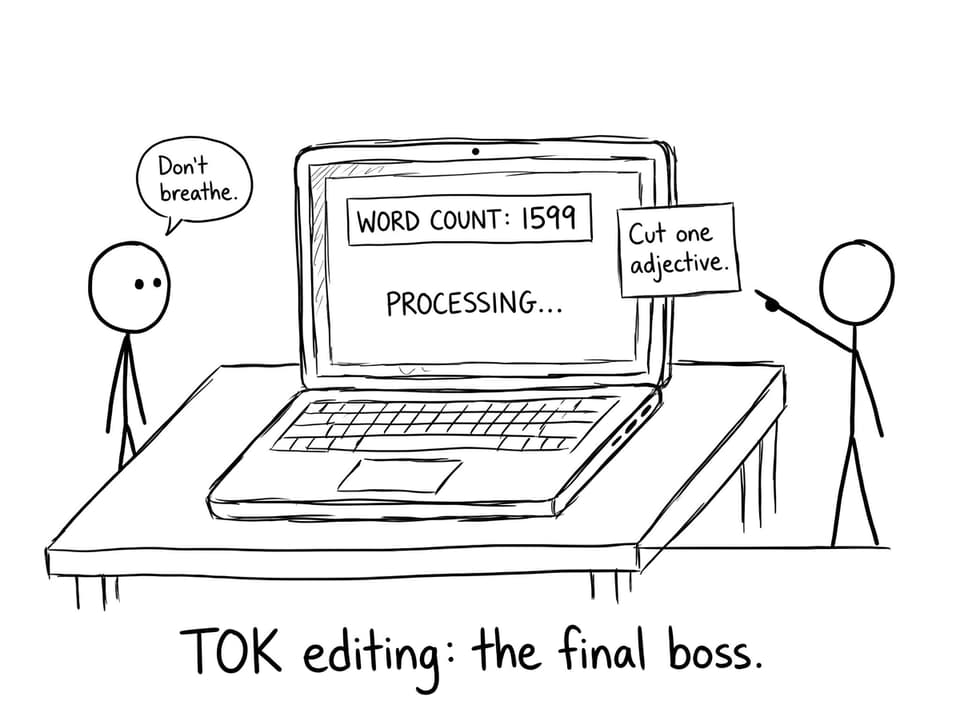
Trying to hit 1,400 words on the first draft is like trying to run fast while tying your shoes. Draft freely, then edit with intent.
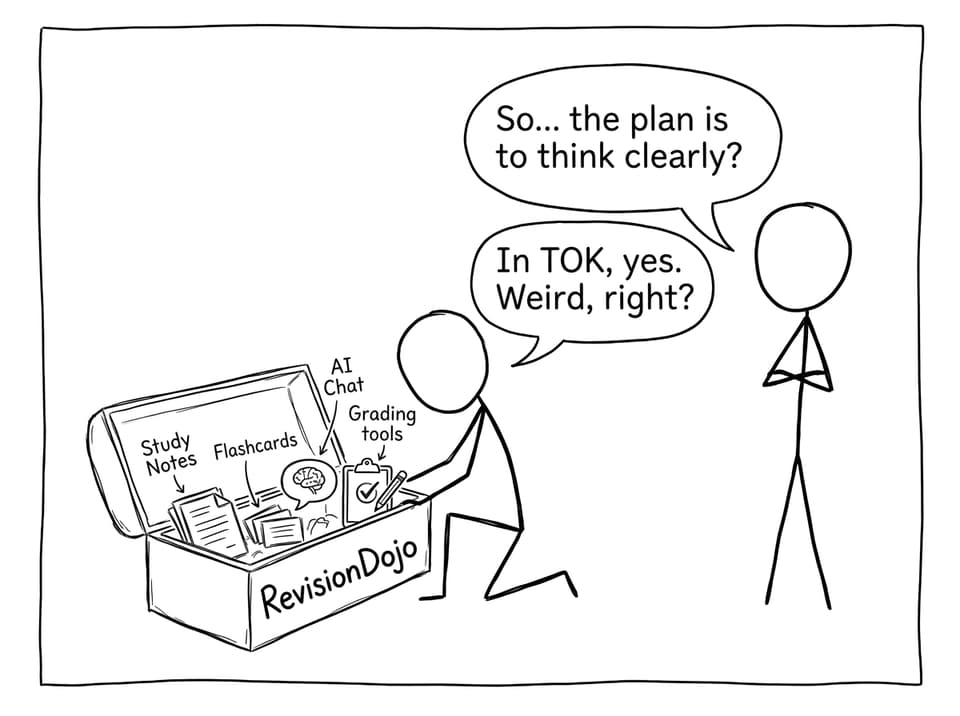
This is where RevisionDojo becomes a practical advantage: write your TOK draft, then use Jojo AI Chat to challenge definitions, spot repetition, and stress-test whether each paragraph links to the title. After that, use the Grading tools in the RevisionDojo Grader to see if the extra paragraphs are actually increasing rubric alignment.
Building a smarter TOK workflow with RevisionDojo
Word count becomes easier when your thinking is organised.
-
Use Study Notes to keep TOK terms sharp and consistent across your draft: IB Theory of Knowledge resources and the focused hub IB Theory of Knowledge 4.2 the TOK Essay.
-
Use Flashcards to memorise clean definitions of key TOK concepts so you stop redefining them mid-essay.
-
Use AI Chat to test whether your claim actually answers the prescribed title (students often drift without noticing).
-
Use the Coursework Library to see what “enough depth” looks like at 1,600 words: IB Theory of Knowledge (TOK) examples.
-
Use Tutors when you need a human to challenge your argument logic, not just your grammar.
And while TOK is your focus here, the same revision system that helps you write clearly also helps you prep for finals: RevisionDojo’s Questionbank, Predicted Papers, and Mock Exams keep exam momentum going while TOK deadlines pile up.
Final thoughts: the best TOK essays feel inevitable, not endless
A strong TOK essay is not long because you had more thoughts. It is long because you chose the right thoughts and refused to waste space.
Stay under 1,600 words, aim for the 1,300-1,500 sweet spot, and treat every paragraph as a decision: does it sharpen my answer to the prescribed title?
When you want that process to feel less like guesswork, make RevisionDojo your home base. Use Study Notes, Flashcards, AI Chat, Grading tools, the Coursework Library, Tutors, and exam-focused tools like Questionbank, Predicted Papers, and Mock Exams to keep your TOK writing clear while the rest of the IB keeps moving.
Ready to tighten your draft and hit the word limit with confidence? Start here: Join RevisionDojo.