
If you have ever refreshed your inbox and felt your heart rate spike at the subject line “University decision,” you are not alone.
A conditional offer is a strange kind of hope: a yes that still asks you to prove yourself. It can feel like someone handed you a golden ticket, then wrote tiny footnotes underneath in permanent marker.
For IB students preparing for exams, the good news is that conditional offers are usually predictable. The wording is formal, but the logic is consistent. Once you understand what a University conditional offer typically includes (and what it rarely includes), you can plan your revision with more clarity and less panic.
Typical University conditional offers (quick checklist)
Use this as your fast decode guide when a University email lands:
-
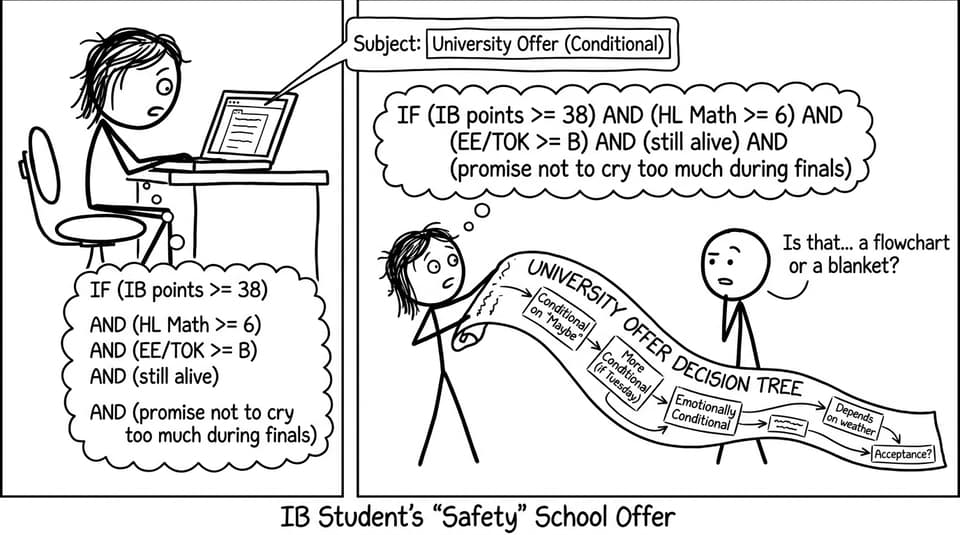
Total IB points requirement (example: 36 points).
-
Higher Level (HL) grade profile (example: 666 at HL).
-
Subject-specific condition tied to the course (example: Math AA HL 6).
-
Diploma awarded requirement (not just “completed the IB”).
-
Sometimes an English language requirement (especially if you are not studying in English).
Then ask one calming question: Which of these is the real bottleneck for me? It is often one HL subject, not “everything.”
To understand the predicted-grade side of this, pair this article with Do IB Predicted Grades Matter for Conditional Offers? and keep your plan grounded in what your University is actually using.
What a University conditional offer really means
A University conditional offer is basically a promise with a clause. The admissions team is saying: “We want you, assuming your final results match the academic signal we admitted you on.”
That signal is often built from predicted grades, your transcript, and (depending on the country) your personal statement, activities, or interviews. In systems where offers are made before final exams are sat, the University needs a clean way to confirm you can handle the program.
IB fits this logic neatly because it is standardized. A “36 with 666 at HL” tells a University something concrete: not just that you can work hard, but that you can perform under timed assessment pressure.
If you want a deeper look at how schools form those predictions, read How to Interpret IB Predicted Grades and Improve Them. It helps you turn “my predicted grades feel unfair” into evidence you can actually improve.
Typical University point ranges for IB students (what to expect)
There is no single global standard, but most University conditional offers for IB students cluster into recognizable bands:
Broad point bands you will see often
-
Mid-20s to low-30s: Often entry to less competitive programs or smaller institutions, sometimes with flexible HL conditions.
-
Low- to mid-30s: Common for a wide range of solid programs where the University wants evidence of consistency.
-
High-30s to low-40s: Typical for competitive courses and highly selective institutions.
-
42+: Usually reserved for the most selective programs or very competitive pathways.
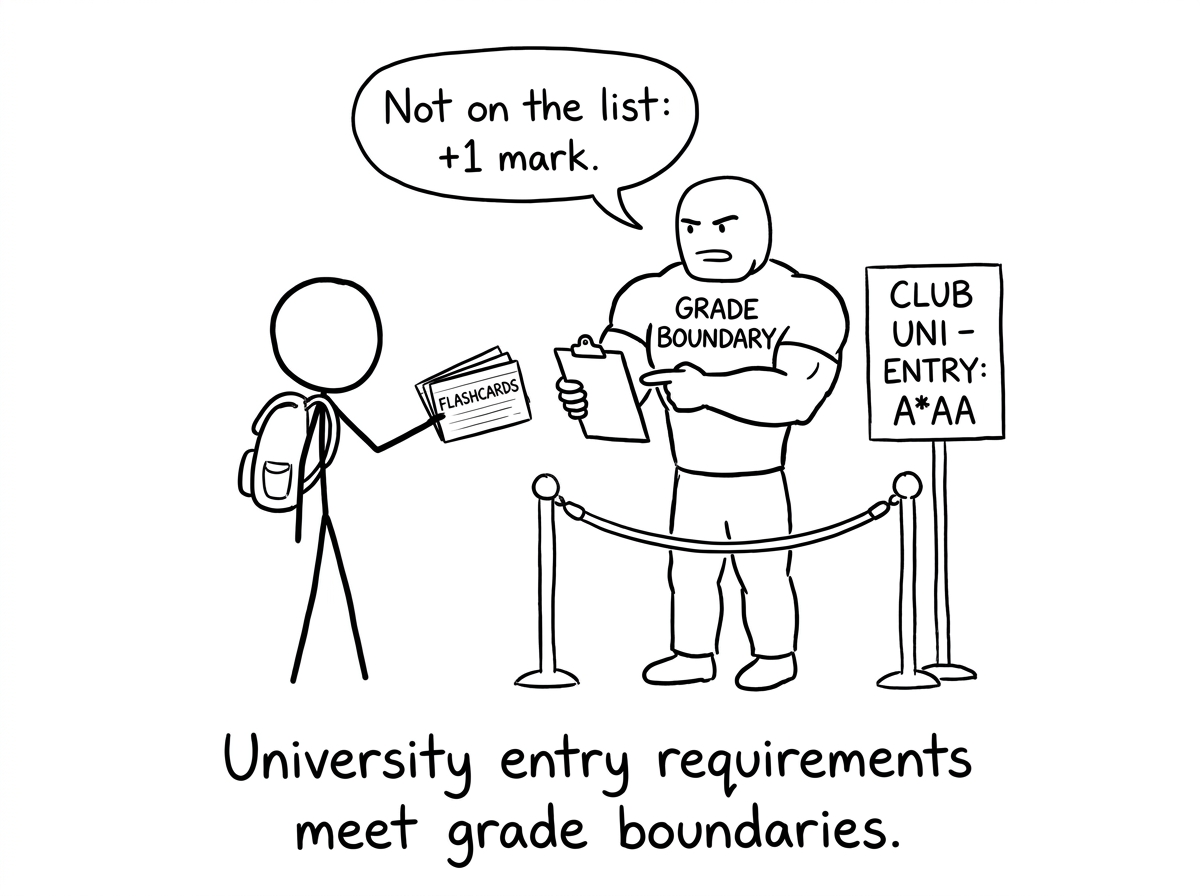
Important: a University rarely cares only about the total. The shape of the score matters. A 38 with weak HL grades can be less useful than a 37 with strong HL grades in required subjects.
The part students underestimate: HL conditions
Most University conditional offers are won or lost at Higher Level.
Why? Because HL subjects are the closest thing the IB has to “specialization,” and a University needs proof you can handle the first-year workload. So the offer often includes:
-
A minimum grade in a specific HL subject (Math, Chemistry, Physics, Economics).
-
A combined HL profile like 765 or 666.
That is why “I just need the total points” is usually the wrong mental model. What you need is to protect your HL outcomes.
One practical way to do that is to make your revision loop brutally specific: learn the concept, test it, review errors, repeat. RevisionDojo is built for that loop: Study Notes for clarity, Flashcards for daily recall, and the Questionbank for targeted exam-style practice.
For system-building, RevisionDojo App: The Smarter Way to Prep for IB Exams lays out a routine you can actually sustain.

Subject combinations and why your University cares
A University offer is not only a score target; it is also a confidence check: did you choose subjects that match your intended degree?
STEM examples
For Engineering, Computer Science, or Physical Sciences, a University commonly expects:
-
Math at HL (often AA HL)
-
One or more sciences at HL (Physics, Chemistry)
Life sciences examples
For Medicine or related pathways, a University commonly expects:
-
Biology and Chemistry at HL
-
Sometimes Math at a strong level
Humanities and social sciences examples
For Economics, Politics, or related programs, a University might value:
-
Strong Math (HL is often helpful)
-
Essay subjects that show analysis and argument
This is why “typical University conditional offers” are always tied to context. A 36 might be demanding for one course and relaxed for another.
Predicted grades: the hidden first gate
Many IB students focus on finals, but a lot of University doors open or close earlier through predicted grades.
Predicted grades matter because they:
-
Trigger the initial decision in systems that issue conditional offers early
-
Shape scholarship consideration
-
Influence how “safe” or “reach” an application appears
If you want the bigger picture, How Much Do Predicted Grades Actually Matter? explains why these numbers feel so powerful (and what you can still control).
When you want to turn predictions into a plan, tools help. The IB Grade Calculator is useful for estimating where you are relative to the kind of University requirements you are seeing.
How to build a calm plan to meet your University offer
There is a quiet advantage in treating your offer like a project, not a mood.
Build a “two-path” plan
Path A: You meet the condition
- Know the next steps (acceptance steps, deposits, housing, visa timeline).
Path B: You miss the condition
-
Know who you will contact first.
-
Decide whether a remark (EUR) is rational.
-
Prepare a polite email template to your University admissions office.
This is not pessimism. It is risk management. The students who look calm on results day are not calmer people. They have fewer decisions left to make.
For a results-day playbook, IB Offer Conditional? What Happens Next (And What to Do) is worth saving now, not later.
Use an evidence loop (not motivational chaos)
A University offer is met through repeatable behaviors:
-
Daily recall: 10-15 minutes of RevisionDojo Flashcards.
-
Targeted practice: small sets in the Questionbank filtered by topic and difficulty.
-
Fast clarification: use AI Chat when you are stuck, then immediately reattempt a similar question.
-
Timed realism: run weekly Mock Exams to train pacing and stamina.
If you also like full-paper rehearsal, browse IB Predicted Papers. They are useful when you treat them as practice under pressure, not fortune telling.
Keep coursework from quietly damaging your outcome
Your University offer is usually conditional on final grades, and final grades include coursework components.
That is why RevisionDojo’s Coursework Library, Grading tools, and Tutors matter in the background. They reduce the “invisible stress tax” of IAs, TOK, and the Extended Essay that can otherwise steal time from exam prep.
If your EE is still draining attention, Mastering IB Extended Essays: How to Research, Write, and Revise is a good reset guide.
Closing: treat your University offer like a map
A University conditional offer is not a verdict on who you are. It is a map: a few numbers, a few subject requirements, and a deadline.
When you turn that map into a weekly routine, the fear becomes smaller. Not because the stakes are fake, but because your actions start to feel proportional.
If you want a single system to do that, build your loop inside RevisionDojo: learn fast with Study Notes, retain with Flashcards, train precision with the Questionbank, get unstuck with AI Chat, pressure-test with Mock Exams and Predicted Papers, and tighten coursework with Grading tools, the Coursework Library, and Tutors.
Your University goal is real. So is your ability to meet it, one calm iteration at a time.