


IB Physics: Why waves feel like “invisible delivery trucks”
In IB Physics, the wave model is one of those ideas that quietly explains half the syllabus. A friend plucks a guitar string and you hear sound across the room. The Sun warms your face across space. A Wi‑Fi signal crosses walls. In each case, something real travels, but not in the way our instincts expect.
What travels is energy, carried by a repeating disturbance. And that’s why waves are such a powerful model for describing energy transfer: they let us track how energy moves without pretending that matter must move with it.
Quick exam checklist for wave energy transfer (IB Physics)
When an examiner asks about energy transfer in waves, hit these points:
-
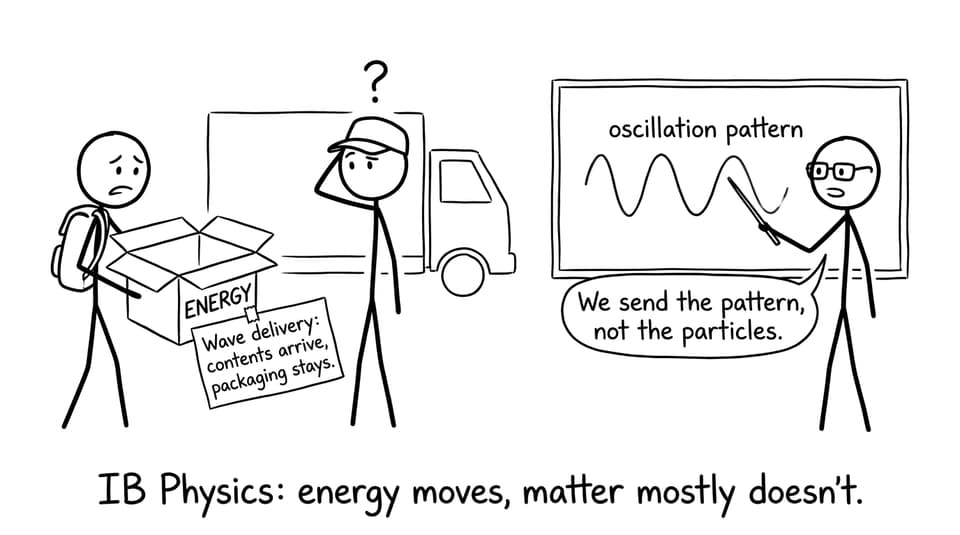
A wave transfers energy (and information) from one place to another with no net transfer of matter.
-
Particles in a mechanical wave oscillate about equilibrium.
-
Energy depends on wave properties (especially amplitude, often amplitude squared).
-
The same wave math (frequency, wavelength, superposition) applies broadly.
-
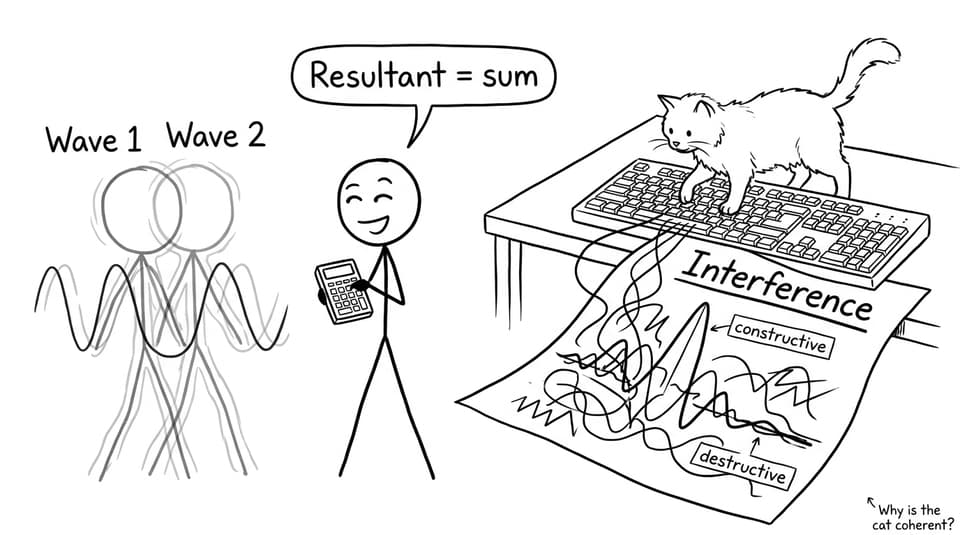
Interference redistributes energy in space while conserving it overall.
For syllabus-aligned definitions and phrasing, pair this with RevisionDojo’s C.2 Wave Model notes and 4.3 Wave characteristics notes.
Waves transfer energy without “shipping” matter
The core power of the wave model in IB Physics is that it separates movement of a disturbance from movement of the medium.
In a sound wave, air molecules don’t travel from the speaker to your ear like tiny messengers. They jiggle back and forth, bumping neighbors, passing along energy. The pattern moves forward; the particles mostly stay local. That’s why you can hear music without the room’s air piling up in the corner.
RevisionDojo explains this clearly in C.2.2 Nature of wave propagation, where the “oscillate about equilibrium” phrasing matches how IB markschemes tend to reward explanations.
The model scales from water to light (and that matters)
A model becomes powerful when it works in multiple worlds.
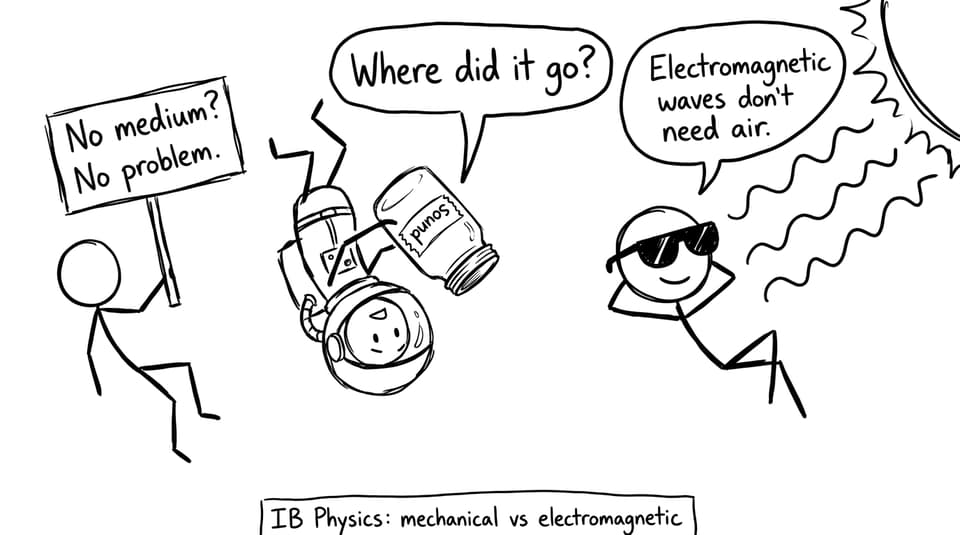
Mechanical waves need a medium. Electromagnetic waves do not. Yet both can be described with the same backbone ideas: frequency, wavelength, amplitude, speed, phase. In IB Physics, that unity is gold, because it lets you reuse thinking across topics instead of memorising disconnected facts.
Light is the most striking example: energy gets from the Sun to Earth through vacuum. The wave model handles this cleanly by treating the oscillations as fields rather than particles in a medium.
To build this foundation, use IB Physics resources alongside the wave units such as IB Physics C.3 Wave phenomena.
The math tells you how energy is distributed
In IB Physics, waves aren’t just pictures; they’re measurable. Once you can describe a wave using amplitude, frequency, wavelength and speed, you can make predictions about energy transfer.
A key exam-friendly link is amplitude and energy. Bigger amplitude means bigger oscillations, which usually means more energy carried (often proportional to amplitude squared for many systems). RevisionDojo’s 4.3 Wave characteristics notes is a good place to lock that relationship into memory.
This is also why the wave model helps you interpret intensity patterns: energy isn’t always spread evenly. Sometimes it concentrates.
Superposition makes wave energy predictable (and examinable)
The principle of superposition is a quiet superpower: when waves overlap, displacements add. That one rule explains interference patterns, beats, standing waves, and many optics questions.
In IB Physics, you’re often rewarded for stating superposition cleanly, then connecting it to constructive and destructive interference via phase difference. RevisionDojo’s Interference notes (9.3) and the explainer How does superposition explain interference patterns? are perfect for that.
If you want to drill this with exam-style practice, go straight to the C.2 Wave model Questionbank or Topic C Wave behaviour Questionbank.
Bringing it home with RevisionDojo
In IB Physics, waves are powerful because they compress messy reality into a model you can calculate with: energy moves forward, oscillations stay local, and superposition explains how energy patterns combine. If you want this to feel automatic under exam pressure, RevisionDojo is built for it: use the Study Notes to lock concepts, Flashcards to memorise definitions, the Questionbank to train markscheme wording, and AI Chat when a diagram or explanation still feels slippery. Add Mock Exams, Predicted Papers, and the Grading tools to sharpen timing and feedback, and you’re no longer “hoping” you understand waves; you’re proving it.