When you finally hit “export to PDF” on your IA, it can feel like closing a chapter. The funny part is that most marks aren’t lost in the big dramatic places (the idea, the ambition, the hours). They slip away in quieter ways: a research question that’s slightly too wide, a method that can’t be replicated, analysis that never quite says “so what,” or formatting that makes a marker work harder than they should.
The good news is that the most common IA mistakes are predictable. And if they’re predictable, they’re avoidable.
If you want a fast look at what strong work actually looks like, start by browsing RevisionDojo’s coursework exemplars. A good exemplar doesn’t just inspire you. It calibrates your sense of what “enough” looks like for an IA.
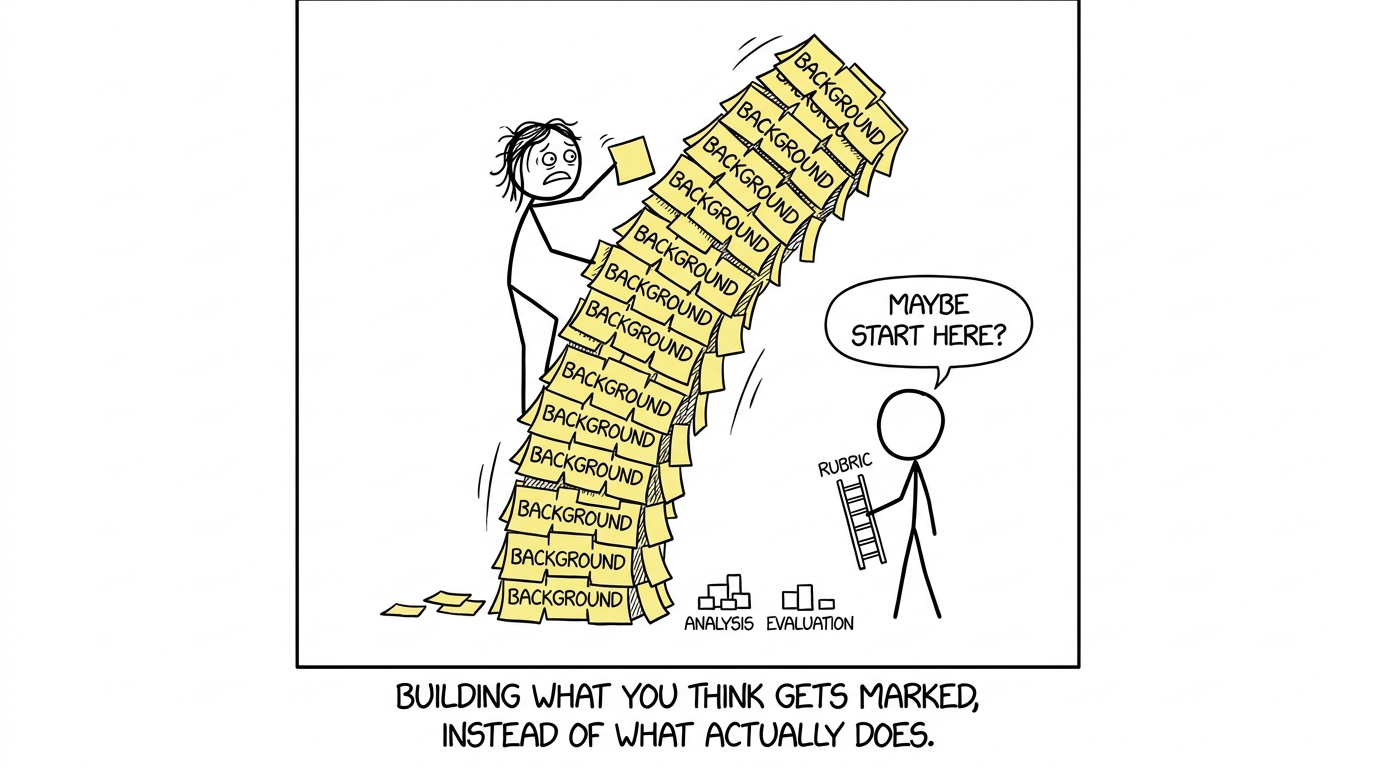
A leaning IA tower missing analysis blocks
IA Mistakes: a quick checklist to self-audit
Use this as a five-minute reset before you write (and again before you submit):
Is my IA research question focused enough to answer with depth?
Does every section clearly earn marks from the rubric?
Do I analyse and evaluate, not just describe what happened?
Am I using my word count for reasoning, not background?
Are my sources and data reliable, traceable, and appropriate?
Is the final draft clean: citations, labels, units, and formatting consistent?
For more subject-specific structure and criteria reminders, the fastest reference is RevisionDojo’s IA Guides.
Mistake: choosing an IA topic that’s too broad
A broad topic feels safe because you’ll “have lots to say.” But in an IA, breadth usually turns into rushed writing. Markers reward depth: precise choices, clear boundaries, and a sense that you controlled the investigation instead of letting it sprawl.
A simple test: if your IA question could be answered by reading three textbooks, it’s probably too wide. If it can be answered with a manageable dataset, a specific case study, or a tight comparison, you’re in the right zone.
Choose one context (time period, location, sample, text, dataset).
Choose one measurable relationship (variable A affects variable B).
Add a constraint (age group, range, conditions, or timeframe).
If you’re stuck, follow a proven path: read one strong model in the same subject from RevisionDojo’s coursework exemplars, then compare how narrow their scope is compared to yours.
Many students treat the rubric like a formality. Markers do not. Your IA is not graded on effort, originality, or how “smart” it sounds. It’s graded on evidence that matches criterion descriptors.
A practical habit: do a “rubric-first outline.” Before you draft paragraphs, draft the marks. Write one bullet per criterion explaining what evidence you will show.
Two useful reads when you want to think like a marker:
If you want a concrete example of how criteria are unpacked, see Language A Internal Assessment (IA) Rubric (even if you don’t take Language A, the principle is the same: descriptors want visible proof).
Mistake: staying descriptive instead of analytical
Description feels productive because you’re writing sentences and adding information. Analysis feels slower because it forces choices: what matters, why it matters, and what it implies.
A quick upgrade rule for almost any IA paragraph:
Description tells what happened.
Analysis explains why it happened.
Evaluation asks how reliable the claim is and what could change it.
After every key result, ask:
“So what does this mean for my research question?”
“What alternative explanation could exist?”
“How confident am I, and why?”
This is where RevisionDojo can speed up your loop. Use Jojo AI Chat to challenge one paragraph at a time: “What would stronger evaluation look like here?” Then convert the recurring fixes into habits using RevisionDojo Flashcards.
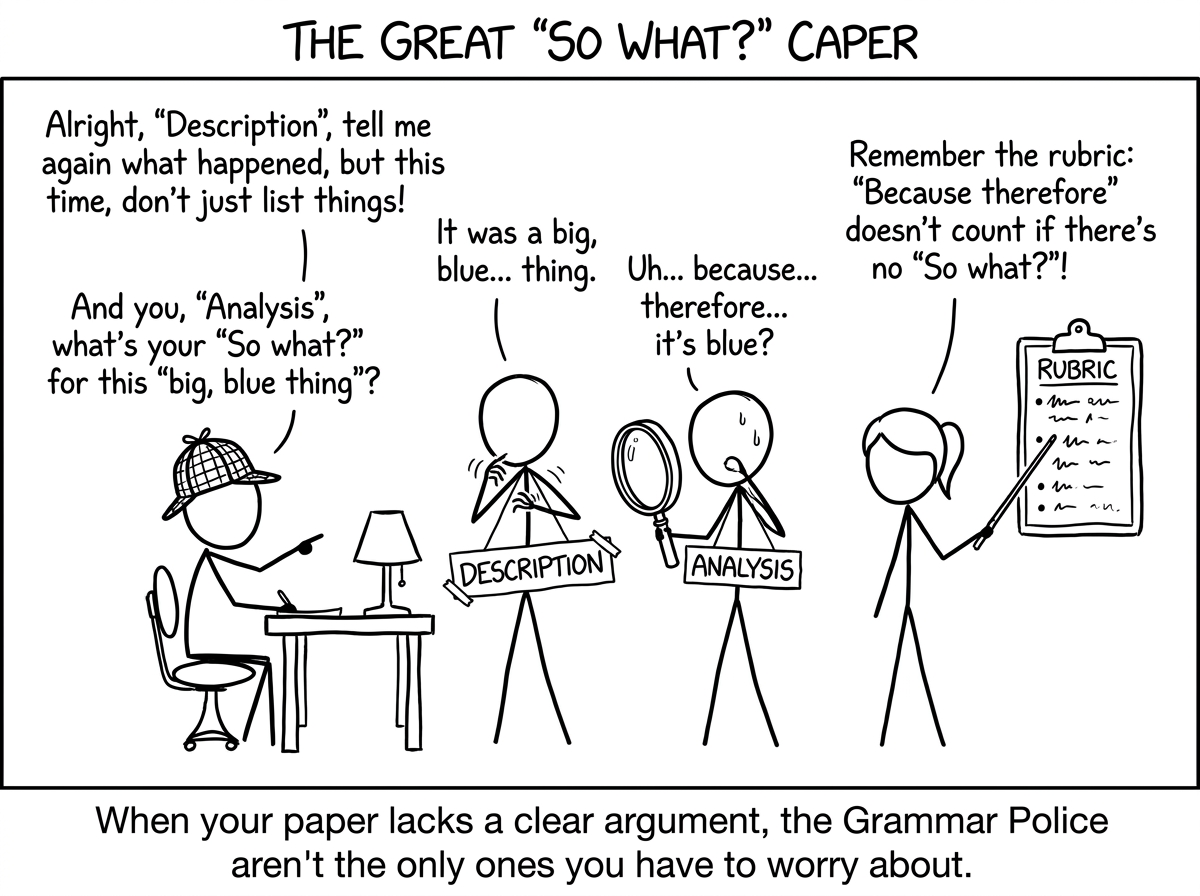
Detective interrogating Description vs Analysis
Mistake: wasting word count on the wrong sections
Your word count is a budget. Most students overspend on introductions and background because it feels like “setting the scene.” Markers rarely award many marks for scene-setting. They award marks for method quality, reasoning, interpretation, and reflection.
A healthier allocation mindset:
Background should exist only to make your investigation understandable.
Your results should be clear and labelled.
Your analysis and evaluation should do the heavy lifting.
If you’re unsure how tight good writing looks within limits, scan a few high scoring samples in RevisionDojo’s coursework exemplars and pay attention to what they don’t include.
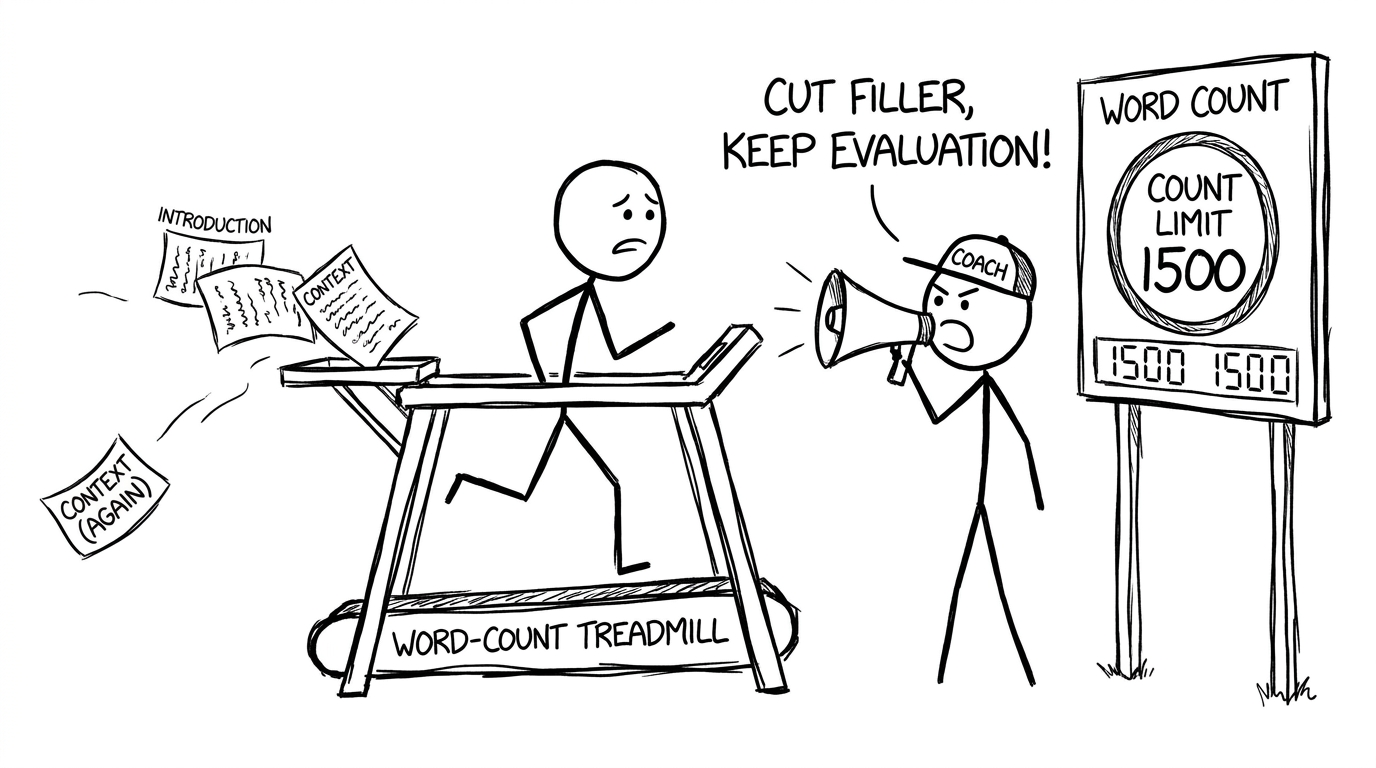
Word-count treadmill with flying “Context” pages
Mistake: using weak sources or shaky data
Your IA can be beautifully written and still collapse if the foundations are unreliable. Markers want traceable, credible, appropriately academic sources and data that is either well-collected or responsibly selected.
Basic rules that keep you safe:
Prefer peer-reviewed articles, academic books, reputable databases, and official reports.
If you use secondary data, justify why it’s appropriate and note limitations.
If you collect primary data, make the method replicable and control variables where possible.
In sciences, this often shows up as vague methodology or missing units. In humanities, it shows up as overreliance on general websites. In all subjects, it shows up as claims that don’t have support.
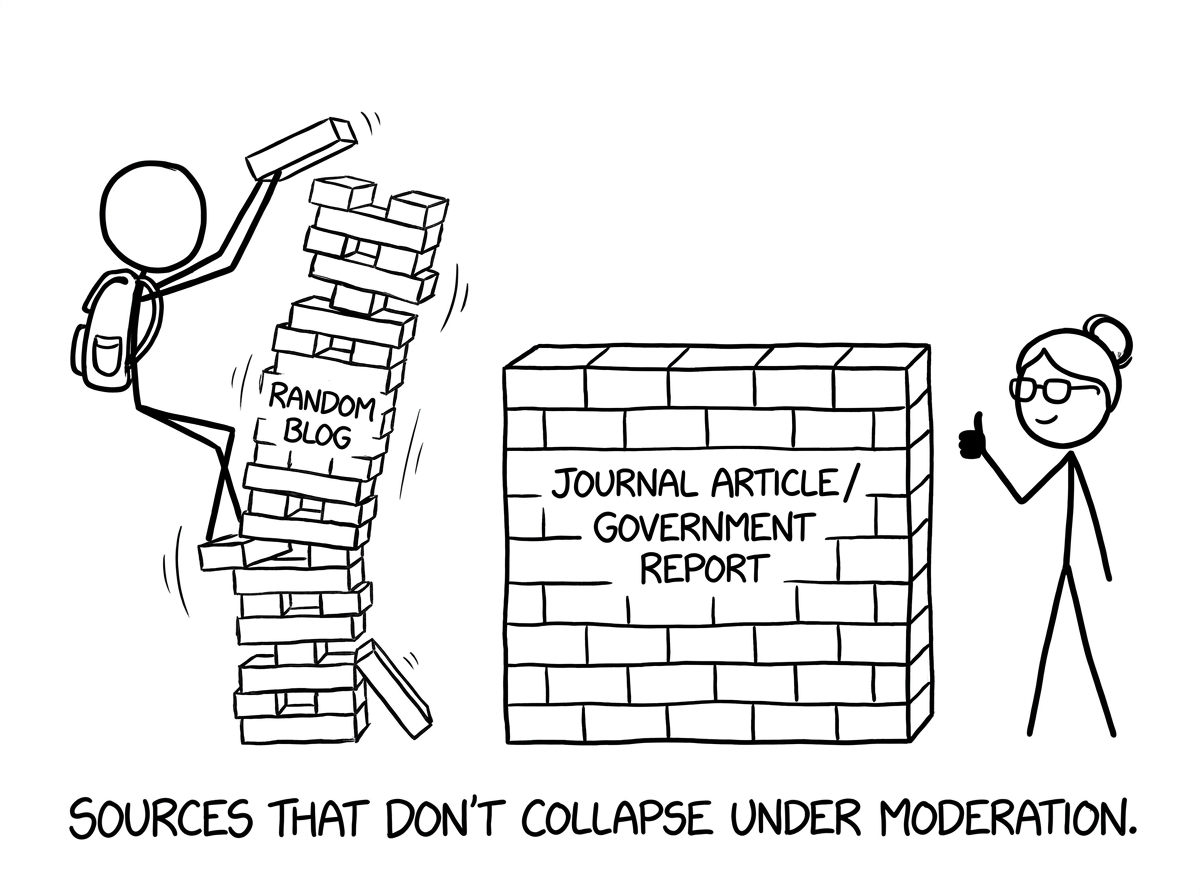
Jenga tower of “Random Blog” vs brick wall sources
Mistake: skipping proofreading and “marker-friendly” formatting
Formatting sounds cosmetic until you realise it changes how your work is read. A marker who can’t quickly interpret your graphs, tables, citations, and headings will miss your best points or spend less time appreciating them.
Final-hour checklist:
Every figure and table is labelled, referenced, and readable.
Units are consistent.
Citations are complete and consistent.
Headings guide the reader through the IA logic.
If you want a structured way to catch issues earlier, use RevisionDojo’s grading tools to make feedback less emotional and more mechanical: identify what to fix, fix it, then re-check.
A simple IA recovery plan (that still protects exam prep)
One trap is letting the IA consume all revision time. Keep a feedback loop, but keep it contained.
A realistic weekly approach:
Two focused IA sessions (rubric-driven revisions only)
The most common mistake in an IA is writing in a descriptive way and assuming the marker will “see” your thinking. In IB marking, unshown thinking is treated as missing thinking. That’s why analysis and evaluation matter so much: they make your reasoning visible. A helpful rule is to add one sentence after each major point that explains significance to the research question. Then add one sentence that challenges your own conclusion with a limitation or alternative explanation. If you do that consistently, your IA stops sounding like a report and starts sounding like an investigation. Over time, it becomes a habit rather than a last-minute fix.
How can I tell if my IA topic is too broad?
Your IA topic is too broad if you can’t explain your method or scope in a few crisp sentences. Another sign is when your draft includes lots of history, context, or definitions just to fill space, because the core investigation isn’t yet precise. If you’re collecting data, a too-broad topic often produces messy data because variables aren’t controlled or defined. If you’re using secondary sources, you’ll notice you’re summarizing multiple angles instead of defending one clear line of argument. The fix is almost always narrowing the context, narrowing the variables, or narrowing the timeframe. Reading a couple of same-subject examples in RevisionDojo’s coursework exemplars helps you feel what the “right size” of an IA question looks like.
What happens if my IA goes over the word count?
If your IA exceeds the word count, you’re taking a risk with the part that matters most: the end. In many subjects, the final sections contain your evaluation and conclusion, which are often where the easiest marks live. Going over can mean the marker doesn’t consider crucial reasoning, even if it’s your best writing. It also signals weak control: like you didn’t decide what was important. The safer approach is to cut background first, then tighten repetition, then compress description. Keep results clear, but spend your words on interpretation and evaluation. If you need a model for concise structure, compare a few high-scoring IA samples in RevisionDojo’s coursework exemplars and mimic their balance.
How do I know if my sources are reliable for an IA?
Reliable IA sources are traceable, reputable, and appropriate for the subject. In practice, that usually means academic books, peer-reviewed journal articles, official statistics, and credible institutions (universities, governments, major research organisations). A reliable source clearly identifies the author, date, and methodology, so you can evaluate bias and limitations. It also lets a reader find the same information again, which is the hidden standard behind “academic.” If you’re unsure, ask: would I trust this source if I had to defend it in front of a skeptical teacher? If the answer is no, replace it. And remember: good sources don’t just add credibility, they make your analysis easier because they give you stronger claims to engage with.
Conclusion: make your IA easy to mark well
A strong IA isn’t the one with the fanciest idea. It’s the one that stays focused, follows the rubric closely, prioritises analysis, respects the word count, uses credible sources, and lands cleanly with careful proofreading.
If you want the fastest way to level up, do two things this week: (1) compare your draft to one high-scoring model in RevisionDojo’s coursework exemplars, and (2) run a rubric-first revision cycle using RevisionDojo’s tools. Then protect your exam prep with daily Flashcards and targeted Questionbank practice, so your IA improves without quietly stealing your final months.
· 2 min read
Why IB IAs Lose Marks (Even When Students Work Hard)
Discover why many IB Internal Assessments lose marks despite effort, what examiners really look for, and how to plan, focus, and analyse effectively.